For many years now, Etsy is a mecca for passionate artists, creators, handmade craft and art sellers, vintage collectors, and anyone in between looking to build a lucrative business out of a hobby.
As an insanely popular online marketplace that boasts around 50 million customers and an array of useful features, Etsy gives you a chance to launch your own business. But, as an Etsy seller, you’ll always be limited when it comes to branding, customer retention, and marketing strategies.
So if you’re looking for a way not only to launch but also to grow your business and stand out from your competition, it might be time to consider some of the Etsy alternatives.
To help you out, we’ve put together a list of the best online marketplaces and eCommerce platforms that can fit any type of product and business model.
9 best Etsy alternatives for sellers
By choosing an Etsy alternative that fits your product and business needs, you get a chance to diversify your sales channels and build a stronger connection with your target audience.
Below, we’ll explore the nine best Etsy alternatives that offer unique features to help you thrive as a creator and online seller.
1. Sellfy – an Etsy alternative for digital products & print-on-demand
Sellfy is by far the best Etsy alternative for creators, artists, and aspiring entrepreneurs that are looking for an effortless way to build an online store or sell products from an existing website.
And there’s a reason for that — Sellfy combines three aspects of a perfect eCommerce platform:
- It’s easy to use.
- Equally suitable for selling physical, digital, subscription, and print-on-demand products.
- No hidden or unnecessary fees.

Unlike Etsy, Sellfy is an all-in-one eCommerce platform. It means that you get everything you need to start and grow your online business. From hosting, online store, customizable store themes, and powerful marketing tools to built-in store analytics and third-party app integrations.
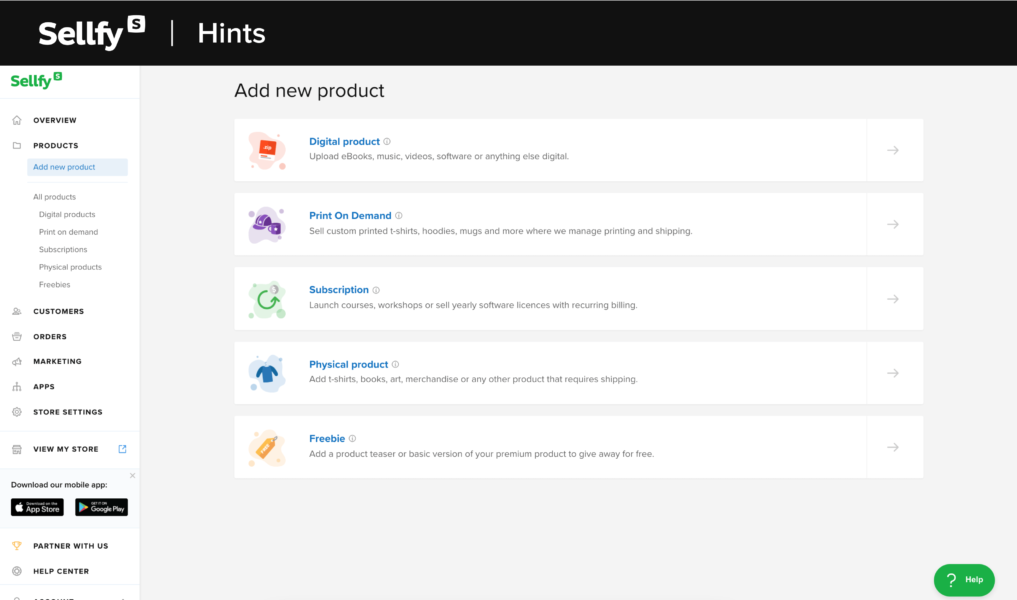
Sellfy allows you to sell any type of product including digital, subscriptions, physical, and print-on-demand goods — all from one place. It means that you won’t have to look for external services in case you decide to roll out your merch.
Thanks to the effortless and hassle-free setup process, it’ll take you no more than 10 minutes to get started. Once you upload a product, you get to choose how you want to sell it — build a professional-looking online store, embed Buy Now buttons or a checkout page into an existing website, share product links on social media, or use other sales channels.

In fact, there are quite a few Sellfy users that migrated their business from Etsy and are happy with their choice.
Why Sellfy is the best Etsy alternative:
- A professional-looking online store
- Unlimited products, storage, and bandwidth
- Built-in email marketing, upselling, cart abandonment, discounts, coupon codes, and other marketing tools
- Store embed options with on-site checkout
- Possibility to add a custom domain
- Multiple payment gateways
- Anti-piracy features
- Third-party apps and services
- 24/7 customer support
- No transaction fees
- Free trial

How much does Selfy cost?
Considering how much Sellfy has to offer, its pricing structure is super affordable and all plans are reasonably priced:
- Starter plan ($19/month)
- Business plan ($39/month)
- Premium plan ($89/month)
2. Big Cartel — an eCommerce platform for artists
Similar to Etsy, Big Cartel is an independent platform specifically built by and for artists to showcase and sell their artwork online. But, unlike Etsy, it’s an eCommerce platform that allows you to build your own online store.

Nevertheless, Big Cartel and many of its features have a distinctly artistic look and feel. So, if you’re an illustrator, graphic designer, or an all-around creative entrepreneur, then you might appreciate Big Cartel’s artsy vibe and consider it an excellent alternative to Etsy.
Big Cartel’s main advantage is its simplicity. The platform is super minimalistic and straightforward — a child can figure out how to use it.
Overall, Big Cartel offers a solid set of eCommerce features and obviously beats Etsy on many accounts. However, when it comes to marketing, unlike Sellfy, Big Cartel doesn’t offer built-in tools to send emails, create coupon codes, use upselling and cross-selling, or craft time-sensitive sales campaigns. Sure, you can expand your sales channels by sharing them on social media platforms or by integrating paid third-party services, but that’s about it.
Make sure to check out our full comparison of Big Cartel vs Etsy.
How much does BigCartel cost?
Big Cartel offers a free plan that allows you to sell up to five products. There are also two paid plans with move features ranging from $9.99/month to 19.99/month.

3. Gumroad — an eCommerce platform without a subscription fee
Gumroad is quite a popular eCommerce platform among artists looking to sell physical and digital art online.
And there’s a reason for that:
It’s a simple and straightforward solution that gives you a head start without making you spend hours creating an online store. But most importantly, Gumromad is free to use, as there are no monthly subscription fees (sort of).

In fact, Gumroad and Etsy are similar (in a way). Both platforms offer a simple way to sell digital or physical products online, whether on an eCommerce platform that allows building an independent online store (Gumroad) or a digital marketplace with an established customer base (Etsy). Moreover, Gumroad has a creative marketplace of its own (just like Etsy, but more inclined towards digital products) called Gumrod Discover.
Gumroad is a pretty basic eCommerce platform with a simple interface. So, it’s a perfect Etsy alternative for someone looking for an effortless way to start selling right this second.
But I must note that such simplicity doesn’t come for free. And by this, I mean not only extreme transaction fees but also a lack of built-in functionality and limited integration possibilities.
Make sure to check out our full comparison of Gumroad vs Etsy.
How much does Gumroad cost?
Even though Gumroad claims to be a free eCommerce platform, it’s not entirely true.
As soon as you start selling, you’ll be charged an extreme 10% commission +30¢ fee for each transaction.

4. Shopify — a popular Etsy alternative
If there was a popularity contest among eCommerce platforms, then Shopify, most probably, could easily take the first place.
Similar to Sellfy, Shopify is an all-in-one eCommerce platform. Meaning that it allows you to move your creative business from a crowded online marketplace to the comfort of your online store. Shopify’s main advantage is that it’s more than just an eCommerce platform, it’s a whole ecosystem that includes 3000+ useful apps and countless store themes.

In other words, with the right set of third-party apps and rich customization possibilities, you can transform your own eCommerce site into anything you want.
There’s a catch though.
Shopify markets itself as an easy-to-use solution. The problem is that it’s not entirely true. Sure, you don’t need development skills, but Shopify still comes with a substantial learning curve. And the fact that tons of “how-to” guides have cropped up to help navigate this platform only proves this fact.
How much does Shopify cost?
- Basic plan ($24/month and 2.9% + 30¢ in transaction fees)
- Shopify plan ($69/month and 2.6% + 30¢ in transaction fees)
- Advanced plan ($289/month and 2.4% + 30¢ in transaction fees)
But you must keep in mind that Shopify charges extra for third-party app integrations on top of the monthly subscription fee. For example, paid store themes cost $140-$180, and monthly app fees can range from a few dollars to $100.

5. Storenvy — a middle ground between an online marketplace and an eCommerce store
Storenvy is a platform that offers an unusual combination of features, making it a middle ground between a marketplace like Etsy and an eCommerce platform like Sellfy or Shopify.

Storenvy positions itself as a “social marketplace” where customers can like listings, add items to “collections”, and message sellers directly. The main difference from Etsy, however, is that with Storenvy you can actually build your own store that is connected to the main marketplace. Moreover, Storenvy offers built-in marketing tools and the option to host your store on a custom domain, which isn’t possible with Etsy.
At a glance, Storenvy seems to be very user-friendly and even fully customizable. Its website builder allows you to make CSS and HTML changes, which is great for those looking for more design and technical capabilities. However, total beginners and those of you who aren’t so familiar with the concept of coding may find Storenvy’s customization possibilities limited in terms of functionality and store control.

How much does Storenvy cost?
Storenvy has a free plan that lets you build a store and sell 20 products. There are also 3 paid plans ranging from $9.99/month to $49.99/month that allow you to sell more products and include more advanced functionality. Storenvy’s marketplace takes a 15% commission from each transaction.
6. Bonanza — an Etsy alternative for selling art and handmade items

It’s hard to call Bonanza an Etsy alternative. It’s more of an eBay alternative for selling unique products like arts and crafts.
Unlike Etsy, Bonanza encourages buyers to make offers to sellers to negotiate prices. Moreover, the platform makes it easy to do so thanks to the feature called “Make an Offer,” which allows buyers to submit an offer to a seller directly from the product listing page. Sellers can then accept, reject, or counter the offer.
Similar to Storenvy, Bonanza is both a marketplace and an eCommerce platform. Therefore, you get to choose how you wish to sell your products.
Firstly, you can set up a Bonanza “booth”, which is similar to an Etsy storefront. One unique thing about Bonanza is that it makes it easy to import items directly from Etsy and other platforms. It also automatically lists your products on Google Shopping, eBay, and Nextag.
The other option is to build a Bonanza Webstore which is an alternative to a standalone eCommerce website. For a flat monthly fee, you get to choose a store theme and adjust your branding. Plus, the Webstore is fully integrated with the Bonanza marketplace.
How much does Banaza cost?
There are no listing fees and no monthly store fees. However, Bonanza does charge you 3.5% of the price at which you sell your product.
Bonanza Websites are priced at $25 per month. It’s not as affordable as Sellfy, but if you compare it to Shopify of Big Commerce, it’s actually more affordable.
7. SendOwl — to sell products from your own website or blog
Sendowl is a perfect alternative for Etsy sellers that have an existing website or a blog (or planning to build one). In essence, it’s a checkout solution that allows you to sell digital and physical products directly from your website by integrating a shopping cart or sharing product links.

SendOwl is a perfect solution for creators and artists who are just tasting the waters of eCommerce as it’s incredibly easy to use. Thanks to the simple interface, uploading your products and configuring a checkout module will take just a couple of minutes.
But wait, there’s more! SendOwl offers a nice set of built-in tools that can help you drive traffic to your store and sell more products. For example:
- Upselling
- Cart abandonment
- Discounts, coupon codes, and vouchers
- Freebies
- Pay what you want pricing
- Affiliate center
But you must remember that SendOwl is that it’s not an all-in-one eCommerce platform like Sellfy, meaning that you can’t use it to build a standalone online store for your products. You can only use it on an existing website.
How much does SendOwl cost?
SendOwl offers three paid plans, all with the same set of features:
- Starter: 3-month free trial, then $9/month + 5% transaction fee
- Growth: $15/month + 0.33 cent per order management fee
- Pro: $39/month + 0.17 cent per order management fee

8. Indiemade — an Etsy alternative for artists and art dealers
IndieMade is an eCommerce platform mainly for artists or people looking to sell art, as it offers some features tailored specifically for artists and art dealers (e.g. accepting commission requests).
Unlike Etsy, Indiemade provides a basic set of eCommerce management tools that allow you to create and manage your own online store. It’s affordable, easy to use, and most importantly it allows you to sell your art outside of the busy marketplace like Etsy.
Speaking of which, Indemade offers an Etsy integration, so its 30-day free trial lets you test things out first without exerting too much effort by migrating product listings.

However, when compared to platforms like Sellfy or Shopify, IndieMade’s eCommerce functionality can be considered somewhat limited. While you can adjust the overall look and feel of your store, it may not provide the same level of control as other Etsy alternatives. This makes it function more like an Etsy store, which may be suitable for some Etsy sellers but those looking for more elaborate branding options may prefer other alternatives to Etsy.
How much does Indiemade cost?
IndieMade compensates quite limited eCommerce functionality with very reasonably priced subscription plans:
- Basic: $4.95/month
- Standard: $12.95/month
- Pro: $14.95/month
- Plus: $19.95/month

9. Poshmark — an Etsy alternative for selling clothing and accessories
This list wouldn’t be complete without at least one marketplace Etsy alternative — Poshmark.
Essentially, Poshmark and Etsy are somewhat similar apart from the fact that they cater to different audiences. I’ll even date to say that Poshmark is an Etsy alternative for Gen Z. Mostly because it resembles a social media platform, with features such as likes, comments, and the ability to follow other users.

Another difference is that Poshmark is mainly focused on fashion and accessories. Sure, you can sell almost anything on there, including your art, handmade products, and vintage goods. But you must keep in mind that clothing and fashion items are the hottest products in this marketplace.
How much does Poshmark cost?
One thing that most sellers love about Poshmark is the simplicity of its fee structure. Listing is free and you will only get charged on Poshmark if your item gets sold. If you sell an item under $15, the listing fee is a flat rate of $2.95. For sales above $15, the fee is 20% and you keep 80%
Online store vs Marketplace?
Essentially, there are just two ways to start selling your physical, digital, print-on-demand, and other products online:
- List them on an online marketplace like Etsy.
- Build your own online store or website.
But, the question remains: which one is the winner when it comes to selling products online?
Let’s compare both ways and see which of the Etsy alternatives should pick and use either.
Key differences
As we all know, Etsy is a creative marketplace that features thousands of products. I would specifically stress the word creative as it mostly offers handmade crafts as well as vintage items. But, overall it’s an ever-growing platform of over 4 million vendors offering unique products to more than 80 million customers worldwide.
An eCommerce platform is an all-in-one solution that allows you to build an online store for your products as well as ensures your complete ownership over it. In other words, it gives you the power to manage every aspect of the selling process.

What is an all-in-one eCommerce platform?
By subscribing to an all-in-one eCommerce platform you automatically get access to the ecosystem of tools necessary to start and grow your business, including hosting, online storefront, customization possibilities, payment processing methods, marketing tools, technical support, etc. One of the best examples of such a platform is Sellfy—an easy-to-use service that allows you to build an online store for your products in less than 10 minutes.
Reasons for switching to an Etsy alternative
Before we start, it’s important to note that Etsy can still be a great option for creators looking to sell arts and crafts items. But, while it may seem an exciting way to start a business for some people it still has a few noticeable drawbacks. One thing, that can’t be forgotten is the insane competition that comes hand in hand with seemingly quick access to a huge customer base. This might seriously impede your long-term success.
In addition to that, there are several reasons why Etsy isn’t the best platform for starting an online business. For example:
Unnecessary added costs.
Just because Etsy is free to start and there’s no monthly fee doesn’t automatically make it a more affordable solution. In the long run, Etsy’s fees can (and will) bite off a significant chunk of your revenue.
Etsy takes an insane 6.5% transaction fee of the total order amount, plus a flat rate charge of $0.20 per listed product. And don’t forget about the checkout fee of 3% + $0.25 per transaction.

Sure, it doesn’t seem like a big deal at the beginning. However, the more you can sell online the more you’ll have to pay in fees. For example, if you list an eBook for $15, you will pay $1.4 for each copy sold. Sell twenty copies in a month and say goodbye to $28.
Customization and branding options
Etsy has one clear advantage over many other solutions — its simplicity, as getting started is really a matter of minutes. But what no one ever talks about is that such simplicity comes at a cost as there is almost no way you can make your Etsy store stand out in a marketplace of identical storefronts.
To succeed in selling products like digital downloads, you need your customer to focus on YOUR product. The last thing you need is your potential buyers getting distracted by similar products offered by other sellers.
On the other hand, if you choose an eCommerce solution like Sellfy, it’s not only as easy to set up but also allows you to put together a professional-grade store that establishes a degree of trust with potential customers.

Building a marketing strategy
Fact: Marketing and customer retention are vital when it comes to selling any type of digital product.
Another fact: It requires extra effort to come up with a successful marketing strategy if you’re selling products on an anonymous digital marketplace like Etsy.
Here’s an example:
A few days ago I bought a couple of Excel spreadsheet templates on Etsy. While I find them really useful, I immediately forgot the name of the store I bought them from as I was looking through so many of them. So, who are we kidding here — what are the chances that I will come back for more?
This simple example proves that it’s almost impossible to make an Etsy store stand out in a marketplace of identical storefronts.
Plus, unlike most eCommerce platforms, Etsy has no built-in marketing features like coupon codes, pay-what-you-want pricing, upselling, list-building, abandoned cart emails, or email marketing. Moreover, Etsy is not built to integrate any of these features through 3rd party apps.

Etsy alternatives: FAQ
What is the best alternative to selling on Etsy?
If you’re looking for an eCommerce platform to build an online store, Sellfy can be considered the best alternative to Etsy. Sellfy offers a user-friendly interface and a range of features to help creators and artists sell their digital products and physical goods online. With Sellfy, you can create your own storefront, customize it to match your brand, and start selling in minutes.
Is it better to sell products on Esty or on your own website?
Selling products on your own website is often considered a better alternative to selling on Etsy. While Etsy is a popular marketplace, it takes a commission on sales, limits your branding, and controls customer communication. Having your own website gives you more control over your business, allows you to create a stronger brand, and allows you to keep all profits.
Is Etsy worth it in 2023?
Etsy might not be the best option in 2023 due to listing and transaction fees, competition, and a lack of branding options. Even though there are no subscription fees, Etsy charges a transaction fee of 5% on top of the listing fee. With increasing competition on the platform as well as limited in terms of branding and customization options it might just not be worth it to sell on Etsy.