Content is intellectual property. Like patents or proprietary data, it’s an enterprise asset that compounds in value over time. The problem? Without content intelligence, you can’t predict what will perform before you publish. You can’t learn systematically from what worked. Your content library — representing millions in investment — sits unused.
Content intelligence uses AI and machine learning to analyze, optimize, and predict content performance automatically. It transforms content operations from guesswork into data-driven IP management. Every piece you publish makes your system smarter.
The result? Content that compounds in value over time.
What is content intelligence?
Content intelligence uses AI and machine learning to automatically analyze, optimize, and measure content performance. It’s not another writing tool or analytics dashboard. It’s a strategic approach to treating content as intellectual property that compounds in value over time.
The technology works from two building blocks: content data and audience data. Content data includes topics, structure, sentiment, readability, and SEO elements. Audience data captures behavior patterns, conversions, time on site, and preferences. Together, they create a feedback loop where every piece you publish makes your system smarter.
Here’s how it differs from what you already use:
vs. Content marketing tools: Those help you schedule and distribute. Content intelligence tells you what to create before you write it.
- vs. Generic AI writing tools: ChatGPT generates text from internet data. Content intelligence learns from your content library using RAG architecture (Retrieval-Augmented Generation), delivering recommendations grounded in what actually works for your audience.
- vs. Analytics platforms: Traditional analytics tell you what happened after you publish. Content intelligence predicts what will perform before you hit publish and guides optimization during creation.
The key is integration. Intelligence separated from creation workflows doesn’t get used consistently. When recommendations live where content gets created, they become part of how teams naturally work. WordPress VIP demonstrates this by integrating content intelligence directly into the WordPress Editor, providing AI-powered suggestions as writers work rather than requiring them to check separate dashboards.
As James LePage, Director of Engineering and AI at Automattic, puts it: “AI should belong to everyone who builds the web.” That means intelligence built into your workflow, not isolated in another tool you have to remember to check.
Why content intelligence matters for enterprise publishers
Enterprise publishers create millions of pieces of content daily, yet most can’t prove ROI. Your teams spend hours researching, writing, and optimizing. The investment is real. The returns? Often unclear.
Without intelligence guiding what you create, you’re gambling with every publish. As Nick Gernert, former CEO of WordPress VIP, put it: “No one wants to say a year from now, ‘Yeah, we created 10x the content but got one-tenth the result.’”
This isn’t just an efficiency problem. It’s strategic. In the AI age, content becomes the foundation for every intelligent experience: personalized recommendations, predictive search, automated optimization. Structured, analyzed content powers these capabilities. Content created without intelligence can’t. When you understand the total cost of ownership for content operations, intelligence becomes non-negotiable.
Content intelligence transforms guesswork into competitive advantage. It tells you what topics will resonate before you assign them, which headlines will drive clicks, and which internal links boost engagement. Your content library shifts from cost center to strategic asset — one that compounds in value rather than depreciates after publication.
Her Campus: 120% growth through intelligent content strategy
Her Campus Media drove a 120% year-over-year increase in organic pageviews by using Parse.ly analytics to identify what actually performed. They doubled down on those topics and formats, transforming content operations from intuition-based to data-driven.
The scale challenge grows with ambition. Creating more content without intelligence creates more noise. Building intelligence into your workflow means every piece makes your operation smarter and your content library more valuable.
How content intelligence works: The technology behind smarter content
Natural language processing and machine learning
Content intelligence starts with understanding what you write. Natural Language Processing (NLP) analyzes tone, readability, topics, and sentiment automatically. It reads your content the way your audience does, identifying what makes pieces clear, engaging, or persuasive.
Machine learning identifies patterns in what actually performs. Which topics drive traffic? Which structures increase time on page? Which internal linking patterns boost engagement? ML finds these patterns across thousands of pieces, turning past performance into future predictions. Your teams get instant feedback on readability, SEO, and performance predictions as they write.
RAG architecture vs. generic AI tools
Here’s where WordPress VIP Content Intelligence differs from tools like ChatGPT.
RAG (Retrieval-Augmented Generation) pulls from your specific content library and performance data before making suggestions. It’s not generated from generic internet content. It learns from what works for your audience, on your site, with your brand voice. This approach grounds AI in your reality rather than broad internet patterns.
Generic LLMs work from internet-wide training data, which means they sometimes suggest ideas that sound plausible but don’t match your context or audience. RAG-powered intelligence stays grounded in your actual performance data. When it suggests a headline structure, it’s because that structure performed well in your library. When it recommends links, it knows which pieces actually drive engagement for your readers.
WordPress VIP connects content intelligence directly to your library and Parse.ly analytics, ensuring every suggestion is contextually relevant and based on real performance.
Integration with content management systems
Content intelligence only works if it’s built into your workflow, not bolted on. When recommendations live in separate dashboards, teams have to remember to check them. When intelligence integrates into the editor, it becomes part of how content naturally gets created.
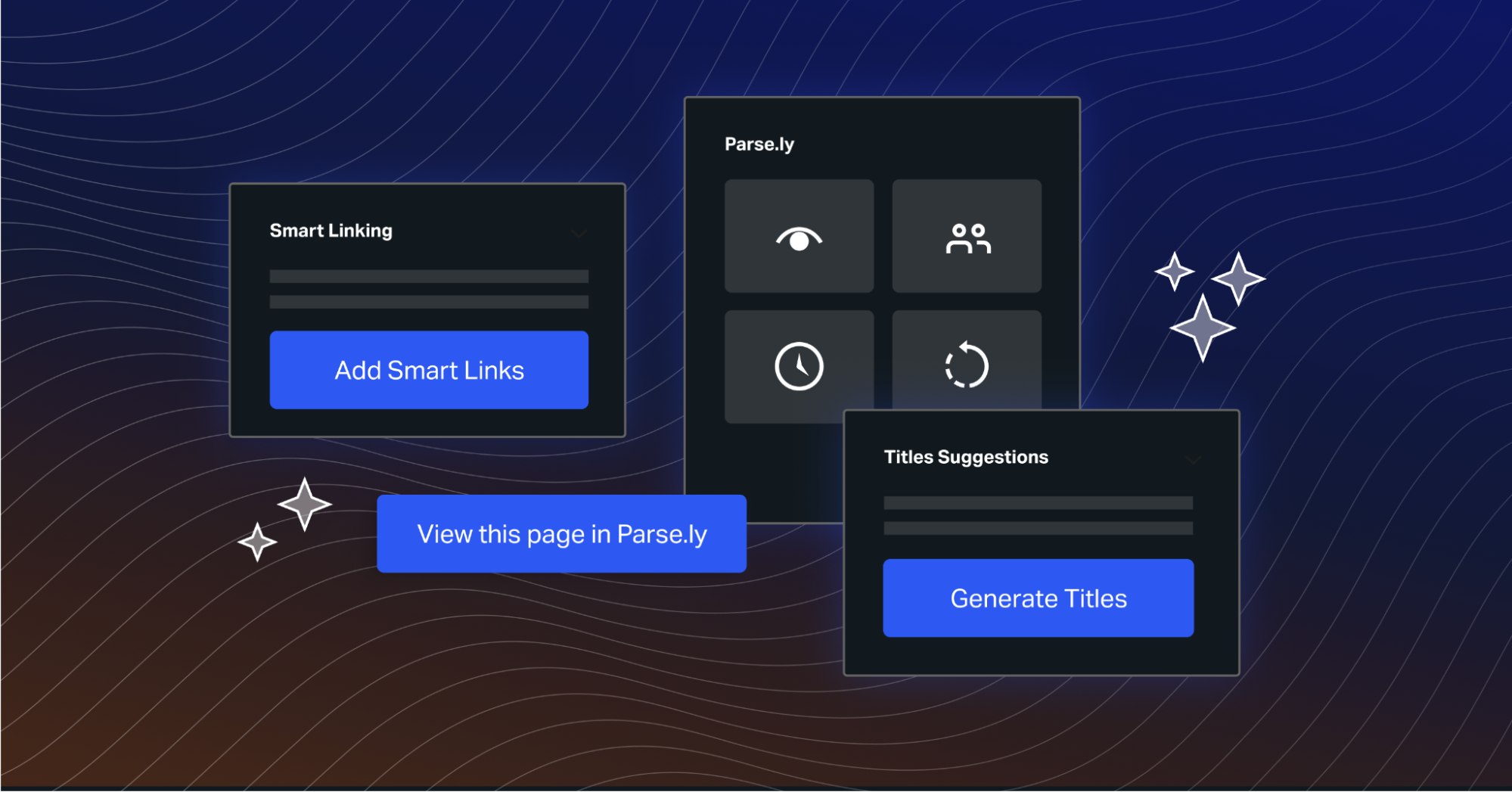
WordPress VIP integrates intelligence directly into the WordPress Editor. Writers get real-time recommendations as they work: title suggestions, SEO guidance, smart linking. No separate login. No switching tools. The system learns from your library over time, making recommendations sharper with each published piece.
As Brian Alvey, CTO of WordPress VIP, puts it: “We keep a human in the loop… and we show our work.” The AI suggests, your team decides, and every decision makes the system smarter.
Key capabilities of content intelligence platforms
Content intelligence emerged because traditional content tools solve isolated problems. You have an analytics dashboard here, an SEO tool there, a writing assistant somewhere else. None of them talk to each other. None of them learn from your specific content library.
Modern content intelligence platforms integrate three core capabilities that actually work together:
Analysis that understands context
The best systems analyze both what you write and how audiences respond. Natural language processing evaluates readability, tone, and structure. Machine learning identifies which headlines drive clicks, which topics generate engagement, which internal links keep readers on site.
The difference from standalone tools? Context. A generic AI might suggest a catchy headline. Content intelligence suggests a headline structure that performed well for your audience on similar topics in your content library. This includes automated SEO recommendations, readability scoring, voice consistency checks, and smart internal linking based on actual user behavior patterns.
Predictions before you publish
Traditional analytics are autopsies. Content intelligence is a forecast. Before you hit publish, you know whether a piece will likely drive traffic, where it might rank, which audience segments will engage.
This happens through predictive analytics trained on your historical performance data. The system identifies patterns: topics that consistently perform, structures that drive conversions, publishing times that maximize reach. It segments your audience by behavior and predicts how each piece will resonate. Some platforms add A/B testing automation and content ROI attribution, connecting individual pieces to business outcomes.
Workflow integration that compounds learning
Here’s what separates real content intelligence from bolt-on tools: it learns continuously because it lives where content gets created.
When intelligence integrates with your CMS, it sees everything. Which suggested headlines you chose. Which internal links you added. What performed after publication. Every decision feeds the system, making future recommendations sharper.
WordPress VIP demonstrates this integrated approach with Parse.ly analytics and Content Intelligence built directly into the WordPress Editor. Writers get real-time suggestions as they work. The system uses Parse.ly Smart Tags for automated categorization and the Content API for personalized recommendations, all learning from unified data rather than siloed systems.
As Nick Gernert, CEO of WordPress VIP, asks: “What would the world look like if we stopped spending a lot of time in the editorial or creation process, wondering how we’ll consistently categorize things?” The shift happens when intelligence handles the repetitive work, freeing teams to focus on creativity and strategy.
Content intelligence vs. traditional content analytics
The terminology gets confusing. Analytics, intelligence, insights — they sound similar, but the differences shape how effectively you can treat content as strategic IP.
Traditional analytics are descriptive and retrospective. They answer “what happened?” You published an article. It got 10,000 pageviews. Users spent 2 minutes on page. Good? Bad? You interpret manually and hope the patterns you identify are actually meaningful.
Content intelligence is predictive and prescriptive. It answers “what should I do next?” It identifies patterns across thousands of articles to predict what will perform. It recommends specific actions: write about this topic, use this headline structure, publish at this time, link to these pieces.
| Feature | Traditional analytics | Content intelligence |
|---|---|---|
| Insights | Descriptive (what happened) | Predictive + prescriptive (what to create next) |
| Timing | After publication | Before + during + after |
| Action required | Manual interpretation | Automated recommendations |
| Integration | Separate dashboard | Built into workflow |
The integration difference is critical. When analytics live in a separate dashboard, you check them periodically. When intelligence integrates into your CMS, it guides every decision in real time. This transforms content from a depreciating asset into one that compounds in value, because every piece benefits from the cumulative learning of everything you’ve published before.
The shift from post-publication reporting to pre-publication guidance changes how content teams operate fundamentally. Instead of analyzing what already happened, you’re optimizing what comes next based on what actually works.
Business benefits: Why content intelligence delivers ROI
Organizations implementing intelligent content operations see measurable improvements across performance, efficiency, competitive positioning, and long-term asset value.
Improved content performance
Content intelligence eliminates guesswork. When you know which topics drive engagement, which headlines increase clicks, and which structures improve SEO, you publish content that performs from the start rather than hoping it works.
Engagement rates increase because you’re writing what your audience wants. SEO rankings improve because recommendations match what search engines reward in your niche. Conversions rise because you optimize for business outcomes, not just traffic. Backstage saw 20% more conversions and 25% more revenue after implementing content intelligence while simultaneously reducing ad spend by 10% because organic content performed better.
Resource optimization
Most content teams waste resources on topics that won’t perform. They guess at what audiences want and repeat mistakes because they lack pattern data to guide decisions.
Content intelligence reveals what actually works. You stop producing low-performing content types, eliminate topics that don’t resonate, and focus budget on formats and subjects that deliver results. Savage Ventures increased engagement by 6% per piece using Parse.ly data to inform strategy. As David Webb, Partner at Savage Ventures, explains: “We appreciate the insights Parse.ly provides to both our operations and executive teams… The at-a-glance type insights are perfect for our day-to-day operators and content creators.”
Cycle times improve too. Real-time feedback on readability, SEO, and structure means publication-ready content faster with fewer revision rounds.
Competitive advantage
Content intelligence creates separation in three ways: speed to trending topics, deeper audience understanding, and strategic agility.
Your system identifies emerging trends automatically, so you publish before competitors notice the opportunity. You understand your audience through behavioral data while competitors rely on intuition. When markets shift, intelligence surfaces changes in real time. The Times accelerated publishing while maintaining quality, gaining speed advantage during breaking news cycles.
Content as compounding intellectual property
Traditional content fades after initial traffic. You publish, get some pageviews, then move on to the next piece. Content intelligence changes this dynamic by extending value over time.
The system identifies evergreen pieces worth refreshing and connects new content to your archive through smart linking. Each new piece makes your entire library more discoverable and valuable. What you published last year continues working for you today.
This creates a compounding effect. Year one brings insights from 1,000 pieces. By year three, you’re working with patterns from 10,000 pieces. The intelligence sharpens, predictions improve, and your content operation becomes a competitive moat that competitors struggle to replicate. The organizations that treat content as intellectual property rather than disposable fuel are building advantages that compound over time rather than reset with each publish.
Content intelligence for different use cases
Content intelligence solves fundamentally different problems depending on your business model, but the underlying principle remains the same: turn data into decisions faster than your competition.
Publishers and media companies
News organizations can’t wait for weekly reports to understand what’s working. When breaking news hits, editorial teams need to know immediately which angles resonate, which headlines drive traffic, and when to double down on a story versus moving on.
Content intelligence provides that real-time feedback loop. Performance data flows directly to editorial planning. Topics that generate engagement get more resources. Beats that underperform get reconsidered. Revenue attribution connects individual articles to subscription conversions or ad performance, answering the question every publisher asks: which content actually pays for itself?
The infrastructure matters too. When major news breaks, traffic spikes can overwhelm systems. WordPress VIP delivered 100% uptime during Super Bowl LVIII for Fox Sports and other publishers covering one of the year’s most-watched events, proving that content intelligence requires infrastructure that scales with demand.
Enterprise marketers
Large organizations face a different challenge: maintaining consistency across dozens of brands, regions, and campaigns while still moving fast enough to compete.
Content intelligence provides governance without bureaucracy. The system identifies which messaging works across properties and which content can be adapted for different audiences. This prevents the common trap of recreating similar content repeatedly because teams don’t know what already exists.
Campaign performance becomes visible in real time rather than weeks later. Marketers adjust mid-flight based on what’s actually working, not what they hoped would work. Lead generation content gets progressively smarter as the system learns which topics, formats, and calls-to-action convert prospects at each funnel stage.
Digital experience teams
Customer experience teams need content that works across web, mobile, apps, and email while staying personalized to each user’s context. Building custom solutions for every touchpoint is expensive and slow.
Content intelligence makes personalization automatic. The system learns user behavior and adapts what surfaces, when it appears, and how it’s presented. First-time visitors see different content than returning customers. Early research gets educational pieces while purchase-ready users see product content.
This works across channels without rebuilding for each one. Intelligence tracks performance on every touchpoint and identifies reuse opportunities. A single asset works in multiple contexts, with the system recommending placements based on actual results.
The Content Matters 2023 Report shows how organizations across these categories apply the same core capabilities to their specific challenges. Content intelligence adapts to your business model while maintaining the same advantage: knowing what works before your competitors do.
Implementing content intelligence: what to look for
Not all content intelligence systems deliver the same value. The difference between a tool that transforms operations and one that collects dust comes down to how it integrates with your actual workflow.
- CMS integration matters most. Standalone tools require separate logins, manual data transfers, and context switching. By the time your team checks recommendations in another dashboard, the moment has passed. Real content intelligence lives where content gets created, providing suggestions in real time as writers work. If it’s not embedded in your editor, it won’t get used consistently.
- Learning capability separates intelligence from analytics. Static recommendation engines give the same suggestions to everyone. True intelligence learns from your specific content library and gets smarter with every piece you publish. This learning compounds over time. The system should improve its predictions continuously, not just report on what happened. RAG architecture enables this by grounding suggestions in your actual content performance rather than generic patterns.
- Enterprise requirements can’t be afterthoughts. You need systems that scale to millions of pageviews, handle traffic spikes without degradation, and meet security standards like FedRAMP certification. Support matters too — when content operations are revenue-critical, you can’t wait days for responses. Look for platforms that combine open flexibility with intelligent capabilities and secure infrastructure built to evolve with whatever comes next.
The implementation question isn’t whether to adopt content intelligence. It’s whether your chosen system integrates deeply enough to become part of how your teams actually work, rather than another dashboard they’re supposed to check but never do.
From content creation to content compounding
Traditional content fades after initial traffic. You publish, get some pageviews, then move on to the next piece. Content intelligence changes this dynamic by extending value over time.
The system identifies evergreen pieces worth refreshing and connects new content to your archive through smart linking. Each new piece makes your entire library more discoverable and valuable. What you published last year continues working for you today.
This creates a compounding effect. Year one brings insights from 1,000 pieces. By year three, you’re working with patterns from 10,000 pieces. The intelligence sharpens, predictions improve, and your content operation becomes a competitive moat that’s difficult to replicate.
This is just the beginning. As AI continues evolving, the organizations that treat content as strategic intellectual property — with the right infrastructure to manage, optimize, and compound its value — will build advantages that outlast any single technology shift. The question isn’t whether content intelligence matters. It’s whether your infrastructure is built to evolve with whatever comes next.
WordPress VIP combines enterprise CMS, AI-powered content intelligence, and Parse.ly analytics in one platform. See how leading publishers and enterprises are transforming content from cost center to strategic asset that compounds in value over time.
Request a demo to explore how content intelligence can transform your operations, or get insights from 99 surveyed senior digital leaders about the barriers keeping them from moving from AI experimentation to full-scale adoption.
Related content
Introducing Content Intelligence: From RAG to Riches

Vanessa Hojda García
Vanessa is a writer and content manager. They’ve worked with some of the best SaaS brands like Shopify and Mailchimp. When they’re not working on content, you’ll find them making art, reading a book, or traveling.