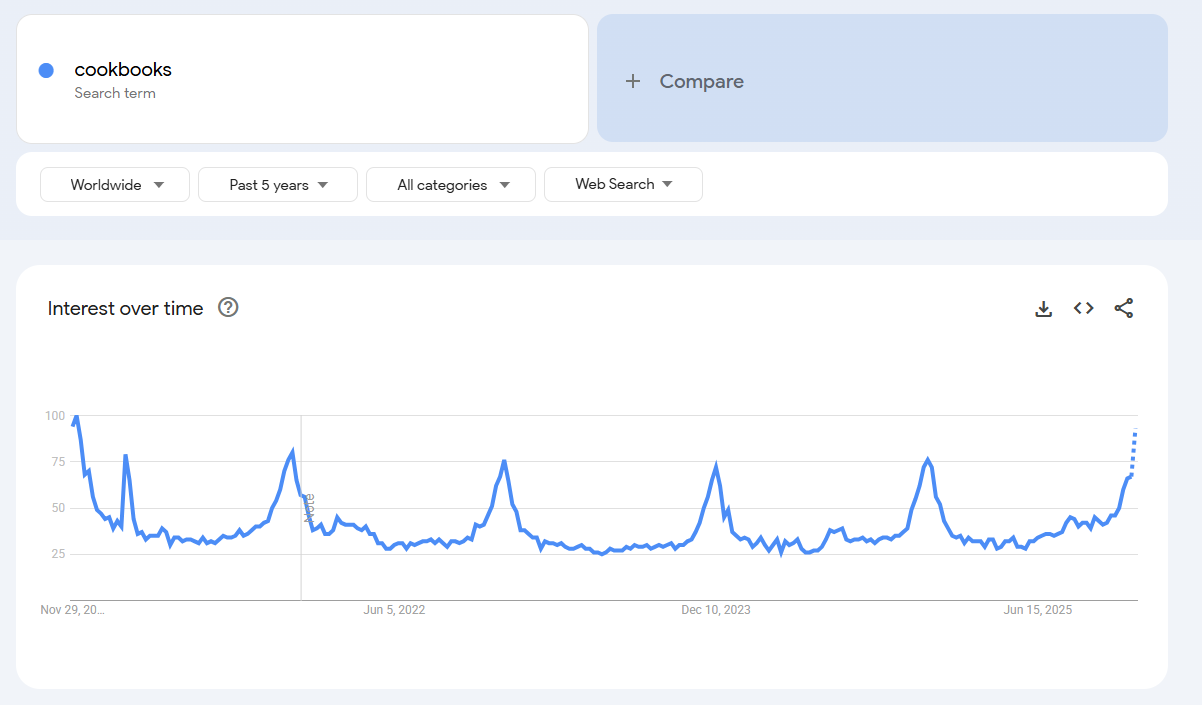
Tracking trends is critical. When a trend is at its peak, you get demand, margins, and fast sales without needing a big upfront budget. The ability to spot high-potential ideas early is what separates successful founders from those who spend all year chasing the market. That’s why I always start with high-demand products to sell.
I run this kind of research on best-selling products every year. I update my data regularly and cross-check it with real marketplaces like Amazon, TikTok, Etsy, Google Trends, and my own storefront results. Then, I check what I see against what sells when creators launch and test products through Sellfy stores. My goal is simple: I want to give you accurate, current insights so you don’t waste time on products that look exciting but never convert.
In this guide, I’ll go through 26 popular product types worth selling in 2026. I’ll also look at smaller niche categories that often “pop” unexpectedly and create quick momentum for new sellers.
Best trending products to sell online in 2026
Here’s a practical and realistic look at trending items selling right now. I’ve included real success stories, marketplace proof, and price ranges to help you understand margins before you launch.
Digital Products
A digital product is a non-physical item made and shared online, including e-books, printables, videos, online courses, and subscriptions. It’s shared through a download or a private link, giving creators an easy way to package useful knowledge or tools that buyers can start using right away and at their own pace.
I always emphasize that selling products online will only keep growing in popularity because people want quick access and simple solutions without waiting for anything to ship. Industry estimates put the digital goods market at $124.32B.
To sell digital products properly, you’ll need an online store builder that makes it easy to create a store and automate digital product delivery, without plugins or third-party tools. I always found Sellfy to be a strong fit for creators. First of all, it was initially made by and for creators to sell digital products, so it has all the functionality you’ll ever need built in. Second of all, it’s super quick and easy to set up.
|
Why it’s a great choice |
||
|
Profit margin: 60–80% |
• Simple to create, no inventory or shipping needed |
|
|
Online Courses & Tutorials |
Profit margin: 70–90% |
• Highly scalable and commands premium pricing |
|
Profit margin: 70–90% |
• Ready-made tools that save users time |
|
|
Profit margin: 70–90% |
• Simple adn quick |
|
|
Profit margin: 70–90% |
• Turns creative work into sellable products |
|
|
Profit margin: 70–90% |
• In demand across film, games, YouTube, and podcasts |
|
|
Profit margin: 70–90% |
• One of the easiest digital products to sell |
|
|
Profit margin: 70–90% |
• Evergreen demand across content marketing |
|
|
Video Assets (LUTs, animations, edits) |
Profit margin: 70–90% |
• Video is the most consumed media type online |
|
Profit margin: 50–80% |
• Package expertise into a service |
|
|
Profit margin: 70–90% |
• Predictable recurring revenue model |
|
|
Profit margin: 80–90% |
• Fonts, icons, and UI kits are building blocks of design |
|
|
Profit margin: 70–90% |
• Evergreen demand for recipes and diet plans |
|
|
AI-Generated Content & Tools |
Profit margin: 80–95% |
• Emerging, fast-growing niche |
|
Profit margin: 80–95% |
• Pre-made products you can rebrand and resell |
1. Recipes & diet cookbooks
Cookbooks turn a way of eating, like keto, vegan, or budget menus, into a weekly meal plan you can quickly package as a digital product. By 2024, the cookbook market was worth about $7.7 billion, and it could reach roughly $11.8 billion by 2032. In the post-pandemic years, interest in home cooking has bounced back.

Product example
Sellfy creator Ashley Renee from Messy Eats took her viral TikTok keto videos and shaped them into recipe eBooks and bundles her audience could cook from. Her fans now head straight to her store for the full versions of the meals they kept asking about.

Pricing
- Average price: $10–20 digital; $20–30 print
- Cost to produce: $0–5 per digital copy; $3–8 per print copy at small runs
- Estimated margin: about 60–80% on digital; 30–60% on print sold direct
Since you only make the files once and can keep selling them endlessly, digital cookbooks often stay profitable even when priced in the middle range.
2. Relocation guides
Relocation guides are city- or country-specific PDFs that turn a messy move (visas, housing, costs, local rules) into a step-by-step checklist you can follow. They’re trending because global mobility is still rising: the UN estimates 304 million international migrants as of mid-2024, which means more people are actively researching moves and looking for practical “do this, then this” answers.

Product Example
Sellfy creator Amel Aitouche (AmelTalks) built an eBook titled “A practical guide to successfully settling in Dubai” after growing a YouTube audience around life in Dubai. In Sellfy’s interview, she says she’s already sold hundreds of copies and even hit her initial sales target in three days after announcing the guide on YouTube.

Pricing
- Average price: $15–35 per relocation PDF (Amel’s Dubai guide is listed at $34.90)
- Cost to produce: $0–3 per digital copy (mostly payment/platform fees; no printing)
- Estimated margin: ~70–85% on digital sales (before marketing and support time)
Since delivery is instant and updates are just file edits, those popular products usually keep strong margins as long as you control research time and buyer Q&A.
3. Travel guides
Digital itineraries, maps, and checklists help people plan their trips more efficiently. Travel demand is back at scale: UN Tourism reports 1.1B+ international tourist arrivals in Jan–Sep 2025, up 5% vs the same period in 2024 and 3% above 2019.

Pricing
- Average price: $7–25 per digital guide/itinerary (PWYW can start lower)
- Cost to produce: $0–4 per digital copy (fees + delivery; research time is the real cost)
- Estimated margin: ~70–90% on digital downloads
Once the route, maps, and checklists are packaged, most extra sales remain profitable: updates are usually small edits, making guides one of the best products to sell from home.
4. Business or apprenticeship guides
These are practical PDFs that walk people through a specific outcome: landing an apprenticeship, passing an interview, or navigating an entry-level career path. Apprenticeships are expanding now, and more candidates compete with “process knowledge”: in the U.S., active Registered Apprenticeships grew from ~360,000 (2015) to over 667,000 (2024).

Product Example
Maia started the platform My Legal Career on Sellfy to document her journey to qualification as a legal apprentice, empower young professionals, and disprove apprenticeship myths.
Pricing
- Average price: $12–35 for a focused career/apprenticeship PDF
- Cost to produce: $0–3 per digital copy (fees; no fulfillment)
- Estimated margin: ~60–85% depending on update/support load
These guides keep strong margins because delivery is instant, but the niche stays competitive: fresh examples and occasional updates matter.
5. Premade emotes & bit badges
Ready-to-use visual packs streamers buy to upgrade their channel branding without hiring a designer. Streaming keeps generating huge creator volume: Twitch’s 2024 recap lists ~21.4M active streamers, so the “long tail” of small channels keeps buying affordable assets.

Product Example
Sellfy creator SilverLyons sells premade emotes and bit badge packs for Twitch streamers through their Sellfy store, mixing paid bundles and occasional freebies.

Pricing
- Average price: $5–20 per themed pack (more for larger bundles)
- Cost to produce: $0–2 per download (fees; file delivery is basically free)
- Estimated margin: ~85–95% once the pack is finished
The economics are great, but the work is front-loaded: clean style consistency + enough variety to stand out.
6. Sheet music
Downloadable scores in PDF and media practice add-ons that help musicians learn, rehearse, and perform faster. Demand tracks the broader shift to paid digital music content. IMARC estimates the global digital music content market at $23.7B in 2024, projecting $48.6B by 2033.

Product example
Austin Farwell built an audience by writing short, emotionally precise pieces that traveled fast on TikTok and Instagram. As the popularity grew, one request kept coming up: the sheet music. Eventually, he stopped emailing PDFs and put the compositions up for sale on Sellfy instead.

Pricing
- Average price: $3–8 per score; $15–40 for bundles/books
- Cost to produce: $0–5 per digital copy (platform + payment processing)
- Estimated margin: ~70–90% on digital products
Once you’ve created the score files, repeat sales usually stay high-margin unless you’re doing constant custom edits.
7. AI-generated art
AI-generated art packs are curated sets of digitally generated things to sell (elements, backgrounds, textures, printables) produced as downloads: buyers can reuse them in their own designs. Grand View Research values the generative AI market at $16.87B in 2024 and projects it will reach $109.37B by 2030.

Product example
Sellfy creator Yude’s Kreationz sells “AI CU Elements” packs: ready-to-use bundles of generated design elements aimed at other creators who need themed assets fast.

Pricing
- Average price: $2–15 per small pack; $15–49 for larger themed bundles
- Cost to produce: $0–3 per copy (plus your tool costs while creating the catalog)
- Estimated margin: ~80–95% on digital downloads (after platform/payment costs)
Margins stay strong when you sell bundles and refresh styles in small batches instead of one-off images.
8. Instagram or AR filters for social media apps
AR filters are interactive face/scene effects used in short-form content and brand campaigns, sold either as a service or packaged as reusable effect assets. Grand View Research projects the augmented reality market reaching $599.6B by 2030, even though Meta shut down Spark AR in January 2025.

Pricing
- Average price: $50–200 for simple filters. $300–1,500+ for branded concepts/packages
- Cost to produce: $0–100 in hard costs (tools are often free; time is the real input)
- Estimated margin: ~60–85% (depends on revision cycles and how tightly you scope delivery)
Those are best things to sell online when you productize the workflow: clear tiers, fixed revisions, and reusable building blocks.
9. Lightroom presets
Lightroom presets are ready-made editing settings that help you get a consistent “look” across photos fast, without rebuilding color and tone from scratch. The pool of people actively editing with tools like Lightroom is growing: Adobe reported freemium product monthly active users (including Lightroom) grew 35% YoY to 70M+, which expands demand for time-saving edit shortcuts.

Product Example
Christian Maté Grab sells Lightroom preset packs (including a flagship “Lightroom Presets Collection”) built for film-like color and quick batch edits, with clear pack structure and mobile/desktop compatibility.

Pricing
- Average price: $10–25 (single packs), $30–$69 (bundles)
- Cost to produce: $0–3 per digital copy (after the initial build)
- Estimated margin: ~70–90% before marketing costs
A preset business stays attractive because once the product is packaged well, each extra sale is mostly upside.
10. Beats, samples packs & drum kits
These are downloadable audio assets (beats, one-shots, loops, drum kits) that creators use to speed up production and keep output consistent. Demand is backed by the scale of sample-based production: Splice has 600,000+ paying users and generates $100M+ in annual revenue.

Product Example
Producer The Nathan is a Sellfy case study for this exact niche, selling beats and scaling to major revenue milestones through downloadable packs.

Pricing
- Average price: $20–$60 per pack, $70–$150 for bigger bundles
- Cost to produce: $0–$10 per download (processing + occasional updates), excluding production time
- Estimated margin: ~70–90% before traffic costs
Pricing works best when the pack has a clear “what’s inside” list and a tight sound theme, so buyers don’t hesitate.
11. Digital planners, illustrated journals & calendars
Digital planners and journals are structured templates, often in PDFs or app-ready formats, that turn routines into a repeatable system. Digital organization keeps expanding right now. Verified Market Research sizes the note-taking app market at $8.59B in 2024.

Product Example
Sellfy seller EfikZara packages the concept into niche planner-style downloads (a calendar + planner format) that buyers can follow as a structured routine product.

Pricing
- Average price: $8–25 per planner/journal; $25–$50 for multi-template bundles
- Cost to produce: $0–3 per digital copy (after design)
- Estimated margin: ~75–90% before marketing costs
Margins stay high, but the product wins or loses on layout clarity and how “ready-to-use” it feels.
12. Instagram post templates
Pre-designed Canva layouts (posts/stories/carousels) that creators and small brands can edit fast and keep a consistent visual style. Template-led creation is now mainstream. Devs says 220M+ people use Canva every month (and users have created 25B+ designs).

Product Example
Sellfy store Blush Bloom Aesthetics sells the “Serene Aesthetic Instagram Canva Template” bundle (68 posts + 68 stories) as a ready-to-edit pack.

Pricing
- Average price: $15–50 per pack (many “full feed” bundles sit mid-range)
- Cost to produce: $0–5 per additional copy (mostly design time upfront)
- Estimated margin: ~80–95% on digital downloads
Templates are hot products, and they usually stay profitable because the same files sell repeatedly, while updates are optional rather than mandatory.
13. AI prompts
AI prompt packs are curated prompt libraries (often in PDFs/Notion/Docs) that help people get better outputs for specific tasks: marketing, study, content, and planning. AI usage is massive: Business Insider reports ChatGPT processes about 2.5B user messages per day, which signals a huge “prompt-as-a-product” audience.

Product Example
ICC Digitale Store sells a “10 Prompts Pack: Detailed Buyer Profile Creation” as a lightweight prompt PDF for building a marketing persona quickly.

Pricing
- Average price: $5–30 (small packs at the low end; big niche libraries higher)
- Cost to produce: $0–2 per additional copy
- Estimated margin: ~90–98% (text-only, no fulfillment)
Pricing works best when the pack is narrow (one outcome) and the prompts are tested.
14. Notion templates
Notion templates are pre-built dashboards and workflows (client portals, trackers, “second brain” setups) that people duplicate into their own workspace to save hours of setup. Notion’s user base is huge: the company’s CEO shared that it passed 100M users (announced Sept 2024).

Product Example
Neat Pages PH sells a “Client Portal + Project Management | Notion Template” as a ready-made client workspace system.

Pricing
- Average price: $10–60 (simple templates lower; business systems higher)
- Cost to produce: $0–3 per additional copy
- Estimated margin: ~85–97%
Templates hold margin because delivery is instant, and improvements can be shipped as version updates to the same file/link.
15. Excel spreadsheets
Spreadsheet templates are pre-built Excel workbooks (budgets, trackers, dashboards) that turn repetitive math and reporting into a plug-and-play file. The audience keeps expanding inside Microsoft 365, which now has more than 400 million paid Office seats.
Google Sheets templates are ready-to-copy cloud trackers, budgets, and dashboards built for sharing and collaborative edits. They’re popular because Google Workspace, where Sheets lives, is trusted by 3B+ users and 10M+ paying customers.

Product Example
Creator Emma turned her Excel know-how into products like guides and template-style files sold through her Sellfy store, after scaling her social audience into the millions.
Pricing
- Average price: $15–$50 per template/workbook (simple trackers lower; dashboards higher)
- Cost to produce: ~$0–$3 per sale (delivery + payment fees; updates/support are the real cost)
- Estimated margin: ~80–95% on digital files before marketing
A clean template with clear inputs + a short walkthrough usually holds value at mid-range pricing without needing constant rewrites.
16. Short films
Self-contained documentaries or narratives you sell direct, often with pay-what-you-want pricing. The category benefits from the wider boom in streaming. Grand View Research estimates the global video streaming market at $129.26B (2024) and projects $416.8B by 2030.

Product Example
Sellfy creators Nils and Kaspars produced the inline-skating short film “Mind Your Step” and sell it on Sellfy with a flexible pricing model; the product is delivered as a download.

Pricing
- Average price: PWYW, commonly ~$5–15 (often with a floor; this example shows “starting from” pricing)
- Cost to produce: ~$0–2 per extra sale (hosting/payment fees), after sunk production costs
- Estimated margin: ~85–95% per incremental sale once production is recouped
PWYW works well here because even small payments stack, and the file can be resold indefinitely.
17. Dance classes
Dance class products bundle video lessons, music, and manuals into a format people can repeat at home or in studios. They can be discussed in the context of a virtual fitness market, which is estimated at $25.223 billion in 2024 and projected to reach $106.437 billion by 2030.

Product Example
The Imperial Society of Teachers of Dancing (ISTD) sells training materials through its Sellfy shop, featuring high-demand products such as instructional videos, alongside music downloads and books.

Pricing
- Average price: ~$15–60 per item (videos higher; music/books lower)
- Cost to produce: ~$0–3 per sale after filming/creation (delivery + processing)
- Estimated margin: ~70–90% per sale on digital delivery (depends on production overhead + support)
Once the lesson is recorded cleanly, the economics improve fast, especially with level-based series that encourage repeat purchases.
18. Graphic design tutorials
Graphic design tutorials are downloadable video lessons often bundled with project files that teach a specific skill fast: logos, layouts, social packs, and workflow shortcuts. The global e-learning services market was estimated at $299.67B (2024) and can reach $842.64B by 2030.

Product Example
FGDesigners is a group of creators from Sweden. They started by making fonts, mockups, icons, and patterns for their own projects, then decided to turn that work into an online store.

Pricing
- Average price: $20–150 per course/bundle (higher if it includes critique or a big asset pack)
- Cost to produce: ~$0–3 per digital sale (main cost is recording/editing time)
- Estimated margin: ~70–90% on digital products
Once the videos and files are built, the economics stay strong: delivery doesn’t scale your costs.
19. Fitness programs & tutorials
Structured weekly plans (training schedule + demos + progress rules) packaged to follow without a coach on call. The category is pulled forward by virtual training adoption: a market outlook puts virtual fitness at $25.223B.
Product Example
Ashley Keller was always frustrated by the lack of prenatal and postnatal workouts online. So, she decided to become a Personal Trainer and Prenatal & Postnatal Exercise Specialist and craft her own workout routines, thus creating GlowBodyPT.

Pricing
- Average price: $30–200 for self-paced programs; $150–500+ if check-ins are included
- Cost to produce: ~$0–5 per digital sale (filming/editing is the upfront cost)
- Estimated margin: ~60–85% (higher when it’s download-only, lower with coaching time)
A clean “program + calendar + demo videos” package usually hits the best time-to-profit ratio.
20. Web design services
Web design services become a “product” when you sell a fixed-scope website package (clear deliverables, timeline, and revisions) through a storefront checkout instead of custom quoting from scratch. Demand stays durable because the web keeps expanding: Netcraft’s May 2025 survey counted more than a billion sites.

Product Example
The Social Style Kit store lists a “Customized Website Package” for $697, showing how a service can be packaged into a ready-to-buy offer.

Pricing
- Average price: $1,500–7,000 for a clearly scoped small-business site; $500–1,500 for “lite” builds
- Cost to produce: mostly labor time (commonly 10–40 hours, depending on scope)
- Estimated margin: ~50–80% if the is tight and revisions are capped
Margins stay healthy when you standardize the stack (pages, sections, handoff) and keep change requests controlled.
21. Graphic design services
Packaged deliverables (logos, brand kits, stream overlays, social templates) sold as a “done-for-you” product. With 5.04B social media users as of Jan 2024, brands and creators publish nonstop, so graphic elements remain high-demand products, too.
Product Example
KondorGFX sells design deliverables on Sellfy (for example, 2D Logo Design and stream/creator visuals), which is a clean “service as a product” setup example.

Pricing
- Average price: $60–300 for single assets; $300–$1,200 for packaged brand/stream bundles
- Cost to produce: $0–30 in direct costs (mainly software + admin); the real cost is time
- Estimated margin: ~70–90% on most orders (higher once a repeatable process exists)
Most designers win by selling fixed-scope packages, so pricing stays simple and delivery stays fast.
22. Custom vocal track or ghost production
Ghost production is a custom music service where a producer delivers a ready-to-release track, often with stems, mix/master options, and clear usage terms. The recorded-music market is still expanding with $28.6B in 2023 and +10.2% YoY, allowing ghost productions to remain in a popular products category.

Product Example
EDM Premium Templates lists ghost production as a Sellfy productized service, letting buyers order production without a back-and-forth sales process first.

Pricing
- Average price: $200–500 for instrumentals; $500–1,500+ for fully custom tracks (higher with vocals/rights)
- Cost to produce: $100–800 (time, session talent, mixing/mastering, revisions)
- Estimated margin: ~30–70% depending on revision load and outsourced vocal costs
Margins swing a lot here, so a tight scope (revisions, deliverables, rights) is what protects profit.
23. Copywriting services
Copywriting services are paid writing packages (landing pages, email flows, product copy) sold with a clear scope and outcome. Digital content creation as a whole is scaling fast, estimated $32.28B in 2024, projected to $69.80B by 2030.

Product Example
Social Style Kit is selling products online on Sellfy that explicitly include copywriting as part of the delivered asset bundle: it’s a service sold as a simple, ready-to-download bundle.

Pricing
- Average price: $150–600 for smaller packages; $600–2,000 for core sales assets (scope-dependent)
- Cost to produce: $0–50 direct costs (tools), plus research time
- Estimated margin: ~70–90% when scope + revisions are controlled
Copy sells best when it’s boxed into outcomes such as “homepage rewrite” or “5-email welcome flow.”
24. Subscription-based podcasts
A subscription podcast is paid audio content (bonus episodes, private feeds, or member-only drops) that turns loyal listeners into recurring revenue. Podcast listening keeps expanding: 2024 data from the Pew Research Center shows 47% of Americans aged 12+ listened to paid “premium” audio.

Product Example
Coach Charlie Caruso sells custom workout plans through his Sellfy store, but for people who want more hands-on support, he offers a 1:1 coaching subscription. It’s a simple way to give clients personalized guidance while building steady recurring income.

Pricing
- Average price: $4–15/month
- Cost to produce: $0–5 per member/month (delivery + tools; content time is the real cost)
- Estimated margin: 70–90% once a workflow is stable
Pricing stays flexible, but recurring tiers work best when the offer is clearly “more access” rather than “more files.”
25. Digital magazines
A recurring content product that packages a niche culture, travel, relocation, and food content into a predictable release cadence. The broader tailwind is paid digital publishing that was estimated at $167.4B in 2024.

Pricing
- Average price: $5–12/month or $40–100/year
- Cost to produce: $0–3 per subscriber/issue
- Estimated margin: 60–85% after tools and payment fees
Margins are strong because distribution is near-zero cost; consistency and production cadence decide whether it scales.
26. Spirituality & astrology subscriptions
This is recurring digital content built around rituals, seasonal planning, readings, and guided audio, usually delivered as a membership with drops across the month. If we take the global wellness economy, the market is valued at $6.3T in 2023 and projected to reach $9.0T by 2028.

Product Example
Attune to the Moon is an example of top-selling items: they offer seasonal subscription packages and recordings of live astrology lectures for members on the Sellfy storefront.
Pricing
- Average price: $11–30/month (seasonal bundles often $30–120)
- Cost to produce: $0–5 per member/month (platform + delivery; time is the main input)
- Estimated margin: 70–90% depending on support intensity
This category stays profitable when content is packaged into repeatable “seasonal cycles” instead of one-off drops.
Best items to resell in 2026
Reselling works best when you pick products that hold value, move quickly, and already have a loyal buyer base. This makes it easy to sell products from home and earn a profit without breaking a sweat.
27. Limited-edition sneakers
Some resale markets move fast, but nothing spikes like a drop of Nike Air Jordan Retro, which starts around $150-$250 and often doubles once pairs hit StockX. The money comes from scarcity: not every size run survives past day one.
28. Designer handbags & accessories
The Louis Vuitton Neverfull stays in demand even at $1,500-$3,000, proving that luxury buyers favor longevity over fleeting trends. Resellers like it because value depreciation is extremely slow compared to fast-fashion flips.
29. Vintage & Y2K clothing
I’ve seen Levi’s 501 Vintage jeans sourced from thrift shops for a few dollars and resold for $25-$150 simply because people love authentic, pre-worn denim. Unlike new clothing, those are the best items to resell, because each piece carries a story, and that sells.
30. Pokémon & MTG trading cards
Collectors chase sealed boxes like Pokémon Scarlet & Violet (usually $100-$150), not for the cards inside but for the unopened status itself. That sealed condition makes prices climb predictably as sets get older.
31. Refurbished iPhones & laptops
With Apple Refurbished iPhones in the $300-$900 range, trust becomes the differentiator: buyers feel safer when the refurb comes from Apple, not a random shop. This confidence makes turnover fast and disputes rare.
Best products to sell on Amazon
Amazon rewards products that move fast, solve everyday problems, and attract repeat buyers.
32. Compact home fitness gear
Demand for space-saving gear keeps brands like Fit Simplify Resistance Bands (≈$10-$20) consistently high in Amazon charts. Those are the best products to sell on Amazon: they sell fast, they’re cheap to ship, require no sizing, and appeal to both beginners and casual home exercisers.
33. Pet grooming tools
Products like the FURminator Deshedding Tool (≈$20-$40) stay evergreen because pet owners buy them repeatedly as older tools wear out. Low return rates and a massive pet-care audience make this category unusually stable for new sellers.
34. Smart home accessories
I’ve noticed that smaller add-ons, such as TP-Link Kasa Smart Plugs (≈$12-$25), outperform larger electronics simply due to their impulse-buy pricing. They hit the sweet spot for buyers upgrading a home without committing to expensive systems.
35. Reusable kitchen essentials
Eco-friendly bestsellers like Stasher Reusable Silicone Bags (≈$9-$30) attract shoppers looking to cut down on single-use plastics. The niche is competitive, but customer loyalty stays strong for eCommerce products with clear quality advantages.
36. Ergonomic workstation upgrades
Items such as the Logitech MX Vertical Ergonomic Mouse (≈$70-$120) keep selling because remote workers continue to invest in comfort and posture. These products benefit from a high willingness-to-pay and strong word-of-mouth among office workers.
|
Why it’s a great choice |
||
|
Profit margin: 60–80% |
• Simple to create, no inventory or shipping needed |
|
|
Online Courses & Tutorials |
Profit margin: 70–90% |
• Highly scalable and commands premium pricing |
|
Profit margin: 70–90% |
• Ready-made tools that save users time |
|
|
Profit margin: 70–90% |
• Simple adn quick |
|
|
Profit margin: 70–90% |
• Turns creative work into sellable products |
|
|
Profit margin: 70–90% |
• In demand across film, games, YouTube, and podcasts |
|
|
Profit margin: 70–90% |
• One of the easiest digital products to sell |
|
|
Profit margin: 70–90% |
• Evergreen demand across content marketing |
|
|
Video Assets (LUTs, animations, edits) |
Profit margin: 70–90% |
• Video is the most consumed media type online |
|
Profit margin: 50–80% |
• Package expertise into a service |
|
|
Profit margin: 70–90% |
• Predictable recurring revenue model |
|
|
Profit margin: 80–90% |
• Fonts, icons, and UI kits are building blocks of design |
|
|
Profit margin: 70–90% |
• Evergreen demand for recipes and diet plans |
|
|
AI-Generated Content & Tools |
Profit margin: 80–95% |
• Emerging, fast-growing niche |
|
Profit margin: 80–95% |
• Pre-made products you can rebrand and resell |
Trending TikTok products
TikTok trends are driven by watch time, replays, and shares. Products blow up when they’re easy to demo in 5–15 seconds, show a clear before/after, and trigger copycat UGC that multiplies demand.
Validate fast: check TikTok hashtags and search variants for lots of recent posts from different creators. Track engagement velocity on videos from the last 24–72 hours. Cross-check Google Trends for sustained viral products growth over days.
37. Snail mucin serums
My For You Page has been full of “barrier repair” before-and-afters, and the name that keeps coming up is COSRX Snail Mucin Power Essence. At roughly $9-28, depending on size, it’s cheap enough for impulse buys yet strong on hydration and texture repair to stay viral instead of fading after one trend cycle.
38. Heatless hair curling sets
Heat damage is the pain point, and Kitsch leans into it with satin and velvet heatless curling kits that deliver waves overnight. Their sets usually sit around $15-30, giving creators an easy “sleep on it and wake up styled” storyline that keeps these tools circulating in beauty TikToks.
39. Under-desk walking pads
On remote-work TikTok, the classic desk shot now almost always includes a slim walking pad humming away under someone’s feet. Models like the Yagud Under Desk Treadmill at about $99 and Lichico or DeerRun pads in the $150-400 range turn step goals into background noise while you work, which is a very easy value story to sell on video.
40. Mini power banks and plug-in chargers
For $30-60, compact Anker Nano power banks and plug-in chargers solve a boring but universal problem: your phone dying halfway through a night out or a content shoot. I like this category because it fits every pocket, works with almost any device, and shows well in “what’s in my bag” and creator EDC videos.
41. Oversized hoodie blankets
Comfort sells, and The Oodie has turned oversized wearable blankets into trending TikTok products. With prices commonly in the $60-$120 band, depending on collab and region, you’re not just selling warmth but a cozy, camera-friendly uniform that people happily show off in hauls and “lazy day” content.
Most profitable products to sell online
Most profitable products to sell online are digital products, customized physical accessories, specialty consumables, niche hobby tools, and high-end refurbished electronics. These categories hold strong margins because buyers pay for speed and convenience (digital), a perfect fit (custom), reliable outcomes (consumables), precision (tools), or trusted premium hardware at a better price (refurb).
42. Digital products
Digital products and downloads are often the most profitable. Each additional sale has near-zero fulfillment cost, margins stay high, and you can upsell bundles, updates, or premium versions without new inventory. Most downloads sell in the $5–$50 range, with many best-sellers clustering around $15–$30, depending on depth and audience.
43. 3D-printed accessories & organizers
I keep seeing small 3D-printed items like modular desk organizers or filament-friendly gadget trays sell far above their material cost, often at $12-45, despite low-cost production. These hot products generate profit from customization: people happily pay extra for something made just for their setup.
44. Specialty pet supplements
The margins on niche pet health items are unusually high, especially for premium-tier brands, where a $25-$40 pouch is inexpensive to resell. The audience is loyal too: once a pet responds well to a supplement, owners rarely switch.
45. Niche hobby tools
Hobbyists are willing to spend real money on precision equipment, which is why items like model tools or scoring kits hold strong demand even at $15-$60. These buyers aren’t casual; they pay for reliability and often buy multiple accessories over time.
46. High-end refurbished electronics
Certified refurb programs, especially for Apple, Dell Ultrasharp monitors, or Logitech MX gear, offer predictable margins because refurb units purchased at 40-60% off MSRP often resell for near-retail. The draw is trust: buyers want premium hardware without paying new-device pricing.
|
Why it’s a great choice |
||
|
Profit margin: 60–80% |
• Simple to create, no inventory or shipping needed |
|
|
Online Courses & Tutorials |
Profit margin: 70–90% |
• Highly scalable and commands premium pricing |
|
Profit margin: 70–90% |
• Ready-made tools that save users time |
|
|
Profit margin: 70–90% |
• Simple adn quick |
|
|
Profit margin: 70–90% |
• Turns creative work into sellable products |
|
|
Profit margin: 70–90% |
• In demand across film, games, YouTube, and podcasts |
|
|
Profit margin: 70–90% |
• One of the easiest digital products to sell |
|
|
Profit margin: 70–90% |
• Evergreen demand across content marketing |
|
|
Video Assets (LUTs, animations, edits) |
Profit margin: 70–90% |
• Video is the most consumed media type online |
|
Profit margin: 50–80% |
• Package expertise into a service |
|
|
Profit margin: 70–90% |
• Predictable recurring revenue model |
|
|
Profit margin: 80–90% |
• Fonts, icons, and UI kits are building blocks of design |
|
|
Profit margin: 70–90% |
• Evergreen demand for recipes and diet plans |
|
|
AI-Generated Content & Tools |
Profit margin: 80–95% |
• Emerging, fast-growing niche |
|
Profit margin: 80–95% |
• Pre-made products you can rebrand and resell |
FAQ
What products will be popular in 2026?
Consumer trend reports from authoritative research institutions such as Nielsen IQ show strong demand for wellness, comfort, sustainability, and affordable AI-driven tech. Industry forecasts also point toward skincare, athleisure, pet care, eco-friendly home goods, and smart accessories as the highest-growth categories. If your store taps into comfort, health, or sustainability, it aligns well with the 2026 best-selling products.
What is the most sold item in 2025?
Global market analyses indicate that the top-selling items worldwide are usually beverages or consumables with massive distribution. In e-commerce, reports from Counterpoint Research consistently show that phone accessories such as chargers, cases, and screen protectors dominate sales due to low price, constant replacement cycles, and a huge audience reach. It’s more practical to think in terms of high-volume categories rather than one universal champion.
How to find out what’s trending online?
If you want to know how to find out what’s trending online, start with data tools, not guesses. I use Google Trends to compare search volume for ideas over time and across regions, then cross-check that with marketplace categories and social feeds.
TikTok’s Creative Center and similar tools show which products, hashtags, and sounds are driving real views and clicks inside trending TikTok products. Add Amazon and Etsy bestseller lists plus your own email signups or waitlists, and you can see both what is hot right now and what keeps selling after the first spike.
What to sell online?
When you decide what to sell online, think in categories instead of chasing one viral product. Digital products, printables, courses, and templates stay attractive because they scale, have almost no unit cost, and work well. Physical products like beauty tools, problem-solving home and kitchen items, pet accessories, hobby gear, and tech add-ons can perform well if you validate demand and margin first.
The safest play is to use this guide as a source of product ideas: test a small set of top-selling items in your niche, then double down on what brings repeat buyers.