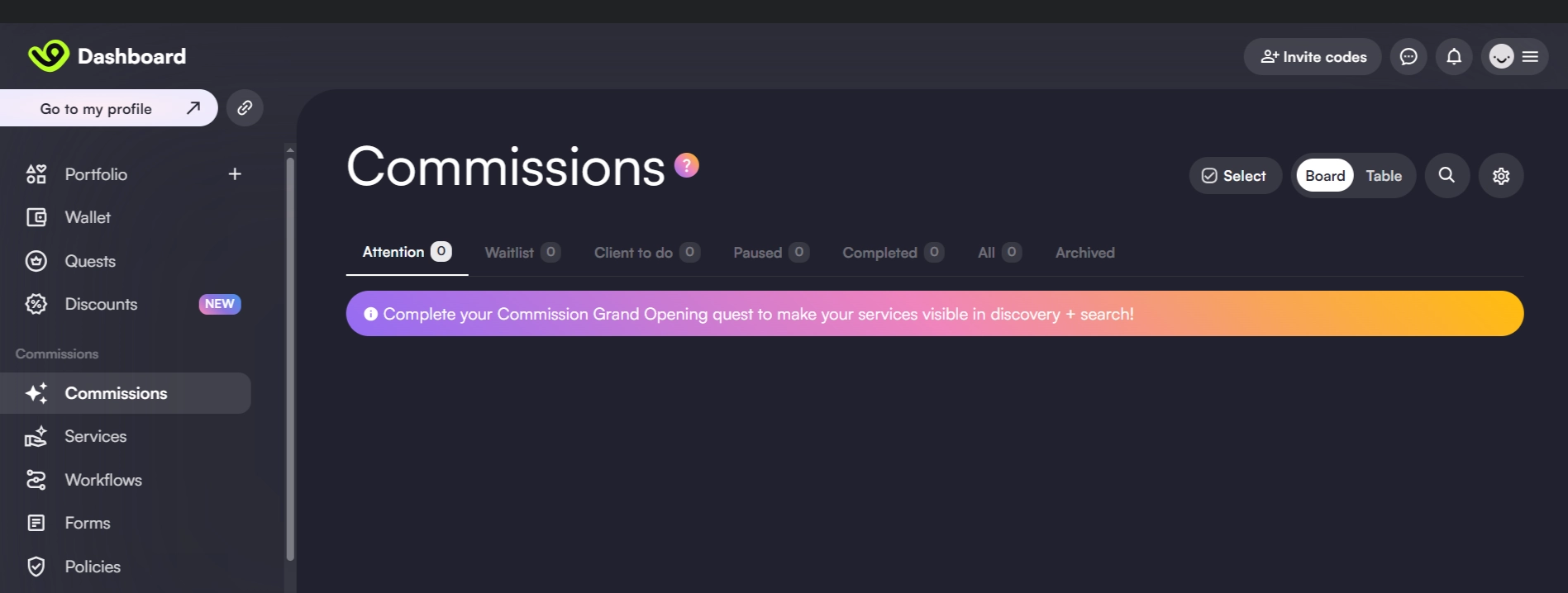
VGen is a creator platform built around commission-based work, where artists sell custom services through structured request listings. Its business model centers on managing commissions end-to-end, with the platform handling payments and basic workflow. For many creators, it works well as long as commissions stay the main product and volume remains manageable.
Over time, most creators start running into the same limits. Income depends heavily on availability and manual effort. Storefront control stays minimal, and selling anything beyond custom work becomes awkward or impossible. Marketing tools are light, repeat buyers are harder to nurture, and scaling usually means working more hours rather than building leverage. That’s where the question of alternatives to VGen naturally comes up.
I personally tested five VGen alternatives that creators often consider at this stage. I looked at how their business models work, what kind of selling they encourage, and where their limits show up in practice. Here is a practical breakdown of those results, with clear recommendations depending on what you want to build next.
My selection and testing process for VGen alternatives
I kept hearing the same thing from creator friends: VGen can be a great jumpstart when you want to start taking commissions fast. Over time, many of them moved on to other platforms. To understand why, I signed up for VGen myself and, after using it for a while, I kept running into a few recurring limits:
- Storefront control stays minimal once you want a more branded setup.
- Monetization is commission-first, so selling products alongside services feels constrained.
- Marketing and analytics tools are light, which makes growth harder to manage.
- Repeat sales take more manual effort than they should, especially once volume grows.
That pushed me to ask around more directly. I ran a quick check-in with creators I know, collected the platforms they switched to most often, and narrowed it down to five VGen alternatives worth testing. I then compared them with the same routine: I set up a profile, published at least one listing, and reviewed the buyer flow from checkout to delivery while checking what growth tools were available.

My criteria stayed consistent across apps like VGen:
- Scalability. Can it handle higher volume without friction?
- Monetization. Can I sell beyond commissions in a natural way?
- Checkout. Does buying feel smooth, fast, and trustworthy?
- Brand control. What about customization, domain support, and access to customers?
|
Commissions + paid add-ons |
Structured commission workflow |
||
|
Digital and physical products, subscriptions, print-on-demand, bundles, physical (self-fulfilled) |
Full creator ecommerce with repeat sales and scaling |
||
|
Buyer-side platform fee 6–7% + processing |
|||
|
Tips, memberships, commissions, small shop items |
Memberships, tips, and lightweight selling |
5% fee on shop/commissions/memberships |
|
|
Commissions (request-driven format) |
Japan-focused commissions with structured request culture |
6–10% commission by category |
|
|
Digital assets (graphics, fonts, templates, mockups) |
Marketplace distribution for digital creative assets |
Sites like VGen in brief
Top 5 VGen alternatives for selling online
Each alternative to selling on VGen on this list comes with its own strengths and quirks. I’m not pushing you toward one “right” choice. I’m laying out solid options for different scenarios, whether you want to scale into a bigger business, switch your distribution model, or move into a new creative direction.
Sellfy: The best all-around VGen alternative
Quick overview
Sellfy is a full e-commerce platform that lets you build an online store with a stronger business model built for direct sales and long-term growth. I used it as my main reference point because it supports digital products, subscriptions, and print-on-demand in one place, which is a big deal once your income stops being only commissions.

Why I picked Sellfy
I picked Sellfy because it’s designed around owning a storefront. You sell directly to your audience, keep the customer relationship, and decide what your business looks like. That’s where VGen vs Sellfy turns into a real choice, since Sellfy is built for long-term e-commerce rather than a commission-first workflow.
The second reason is leverage. Sellfy supports repeatable offers. You can earn from the same audience more than once without reinventing your setup every time. Digital products, subscriptions, and print-on-demand can live under one roof, which keeps the business model clean.
If you’re looking for stores like VGen but want broader monetization and a more “brand-owned” store, Sellfy fits almost any creator who plans to grow beyond custom work.

Standout features
- Built-in print-on-demand (POD). Automatic production + fulfillment through Sellfy’s POD flow (no separate storefront needed).
- Subscriptions. Recurring billing for monthly packs, member-only files, or ongoing drops.
- Upsells at checkout. Add-on offers that raise average order value without extra apps.
- Discounts and coupons. Percentage/fixed discounts plus promo mechanics for launches.
- Built-in email marketing. Send emails from your dashboard to your customer list.
- Storefront and domain control. Direct-to-fan storefront with domain support and brand-first presentation.
Products you can sell
- Digital downloads: PSD, brushes, templates, LUTs, PDFs, asset packs.
- Subscriptions: monthly drops, gated downloads, recurring perks.
- Print-on-demand merch: apparel, posters, accessories, more.
- Physical products: self-fulfilled shipping.

Learn how to sell online the simple way
Integrations
- Google Analytics
- Meta Pixel
- Google Merchant Center
- Zapier
- Webhooks
Pricing
Starter Plan. $29/month with monthly billing or $22/month with annual billing
Best Value Plan (Business). $79/month (monthly billing) or $59/month (annual billing)
Pros and cons
| Pros | Cons |
|
Better than VGen for scaling beyond commissions into products, subscriptions, and POD |
You drive traffic (not a built-in marketplace) |
|
Storefront + domain support makes the brand feel owned |
Commission workflow tools are lighter than commission-first platforms |
|
Built-in email + upsells + discounts reduce tool stacking |
|
|
Cleaner repeat buyer model than commission platforms |
Artistree: Best VGen alternative for commissions
Quick overview
Artistree is a commission management platform designed around custom requests, delivery, and creator profiles. It’s built for commission work, so the flow feels natural for buyers who already know what they want to request.
Why I picked Artistree
I included Artistree because it stays precisely focused on commissions and keeps the buying path simple. The platform’s business model is built around custom requests, so everything is optimized for turning “I want this” into a paid order without extra steps.
The main advantage is structure. You can present scope, add-ons, and terms in a way that feels clear on the buyer side.
Artistree fits creators who want other sites like VGen where commissions remain the core product.

Standout features
- Commission-first flow. Built around turning a request into a paid order with less friction.
- Structured commission offers. Scope, add-ons, and terms feel clearer on the buyer side.
- Platform fee visibility. Costs are easier to anticipate than “custom invoice” chaos.
Products you can sell
- Custom commissions: illustration, character art, design work.
- Add-ons: rush, extra character, extra revision, alternate versions.
- Service-style listings tied to a custom deliverable.
Integrations
Payments and order flow are primarily platform-native. External integrations are not the core value of Artistree.
Pricing
Free. 6.5% platform fee (commission-style model) + payment processing (varies by payment method).
Pros and cons
| Pros | Cons |
|
The commission structure is clear to buyers |
Monetization is commission-centered only |
|
Add-ons and scope framing reduce back-and-forth |
Marketing tools are light compared to e-commerce platforms |
|
Practical for creators who offer custom work |
Expansion into products and subscriptions store needs other tools |
Ko-fi: Best VGen alternative for memberships and subscriptions
Quick overview
Ko-fi is a creator support platform for tips and memberships. It’s a good fit for creators who want recurring support and a simple way to package perks for their audience.
Why I picked Ko-fi
I tested Ko-fi because it gives creators a lightweight way to monetize an audience beyond one-off work. The model leans on tips and memberships, so it’s easier to build a small recurring layer without setting up a full store.
The key advantage is speed. You can start earning from supporters quickly. If you’ll need a bigger e-commerce setup, you can just upgrade your plan.
Ko-fi works best for creators who want platforms like VGen while adding subscriptions with minimal friction.

Standout features
- Memberships and supporter income. Recurring perks plus tips without building a full store.
- Simple shop layer. Lightweight digital storefront on top of your creator page.
- Commission listings. Works for creators who want commissions plus supporter revenue.
- Fee control via Gold. Clear switch between fee-based and subscription-based models.
Products you can sell
- Membership tiers: monthly perks, gated content, exclusive drops.
- Tips/support: “buy me a coffee” style contributions.
- Digital items in the shop: small packs, downloads.
- Commission offerings: creator-defined.
Integrations
- PayPal
- Stripe
- Discord (for member perks/community access)
Pricing
- Starter Plan. $0/month with 5% Ko-fi fee on earnings (Ko-fi’s fee, payment processor fees still apply).
- Best Value Plan (Gold). $12/month with 0% Ko-fi fee on earnings (payment processor fees still apply).
Pros and cons
| Pros | Cons |
|
Great for memberships, tips, and lightweight selling |
Brand control stays limited compared to a full storefront |
|
Gold makes fees predictable for steady earners |
Marketing and analytics are lighter than e-commerce platforms |
|
Easy to add supporter revenue alongside commissions |
Scaling into a larger catalog can feel cramped |
Skeb.jp: Best VGen alternative for Japanese art commissions
Quick overview
Skeb.jp is a Japan-focused commission platform built around request-based commissions. The workflow matches local expectations and keeps the process structured, which changes how commission communication works.
Why I picked Skeb.jp
I included Skeb because it’s one of the most specialized sites similar to VGen, and it’s deeply shaped by the Japan-first commission format. Requests follow a structured flow, and the platform’s norms reduce negotiation, which changes how you manage time and boundaries.
The main advantage is cultural fit, since the request model matches what that audience expects.
Skeb.jp makes the most sense as an answer to where to sell other than VGen when Japan is your core market.

Standout features
- Market-specific commission culture. The request model is built around how that audience expects commissions to work.
- Anonymity-first format. Less creator-buyer social friction in the process.
- Structured requests. Fewer negotiation loops.
Products you can sell
- Commission requests based on buyer themes/prompts.
- Deliverables depend on the creator category and norms on the platform.
Learn how to sell online the simple way
Integrations
Minimal by design. Platform-native workflow is not built to connect to a wider ecommerce stack.
Pricing
- Standard commission. 6%–10%, depending on commission category.
- Promotions. Periodic 0% commission campaigns on selected themes.
- NSFW. Commission terms are handled individually (case-by-case).
Pros and cons
| Pros | Cons |
|
Strong fit for Japan-focused demand |
Limited flexibility outside that market |
|
Anonymity and strict negotiation frameworks |
Storefront control is minimal |
|
Clear structure for request-based work |
Harder to expand into products/subscriptions |
Creative Market: Best VGen marketplace alternative
Quick overview
Creative Market is a digital marketplace for design assets and creative files. It’s built for selling finished products. This marketplace works best for creators who want fast exposure.
Why I picked Creative Market
I picked Creative Market because it shifts the business model to assets. You publish reusable digital products. The marketplace drives discovery through browsing and search. It can scale sales without adding more custom workload.
The key advantage is exposure to buyers already shopping for digital assets.
Creative Market fits creators who want an online marketplace like VGen, especially designers and illustrators selling packs, templates, fonts, or similar files.

Standout features
- Asset-first marketplace model. You sell reusable files instead of selling hours.
- Discovery through browsing and categories. Marketplace traffic can drive sales without building a full funnel first.
- Platform-handled delivery. Buyers get files through the marketplace flow.
Products you can sell
- Graphics, illustration sets, patterns;
- Fonts and typography packs;
- UI kits, templates, mockups;
- Brushes, textures, creative assets.
Integrations
Marketplace-first setup, limited storefront-style integrations. Common creator workflow is off-platform production tools (Adobe, Affinity, Procreate, etc.)
Pricing
Revenue share model. Creator earnings: 50% of net revenue.
Pros and cons
| Pros | Cons |
|
Scales well for reusable products |
Brand control and customer relationship stay marketplace-led |
|
Marketplace discovery helps with early visibility |
Platform rules shape pricing and presentation |
|
Platform-handled delivery and payment flow |
Revenue share affects margins on every sale |
Which VGen alternative is the best?
Sellfy is the most universal option in this list. If you want to scale, automate more of the selling flow, and move your creator business to a higher level, it’s the clearest fit. It supports multiple monetization models, gives you stronger brand control, and makes repeat sales feel natural, which is why it stood out most for creators looking for sites better than VGen for long-term growth.
The other options are more specialized, and that’s the point. Artistree is the closest pick when commissions are your main product, and you want a clean, structured request flow. Ko-fi works best for memberships and supporter income when you want a light setup and quick recurring revenue. Skeb.jp fits creators serving a Japan-based audience with a request format shaped by local expectations. Creative Market makes sense when you want marketplace discovery and scalable digital product sales, with the usual trade-offs in customer ownership.

Aleksey is a Content Marketing Specialist at Sellfy. He loves using language and the power of words to make even the driest eCommerce topics fascinating. Using his degree in literary studies and passion for the latest trends, he creates well-researched and structured content to inspire other people and help them grow their eCommerce business.