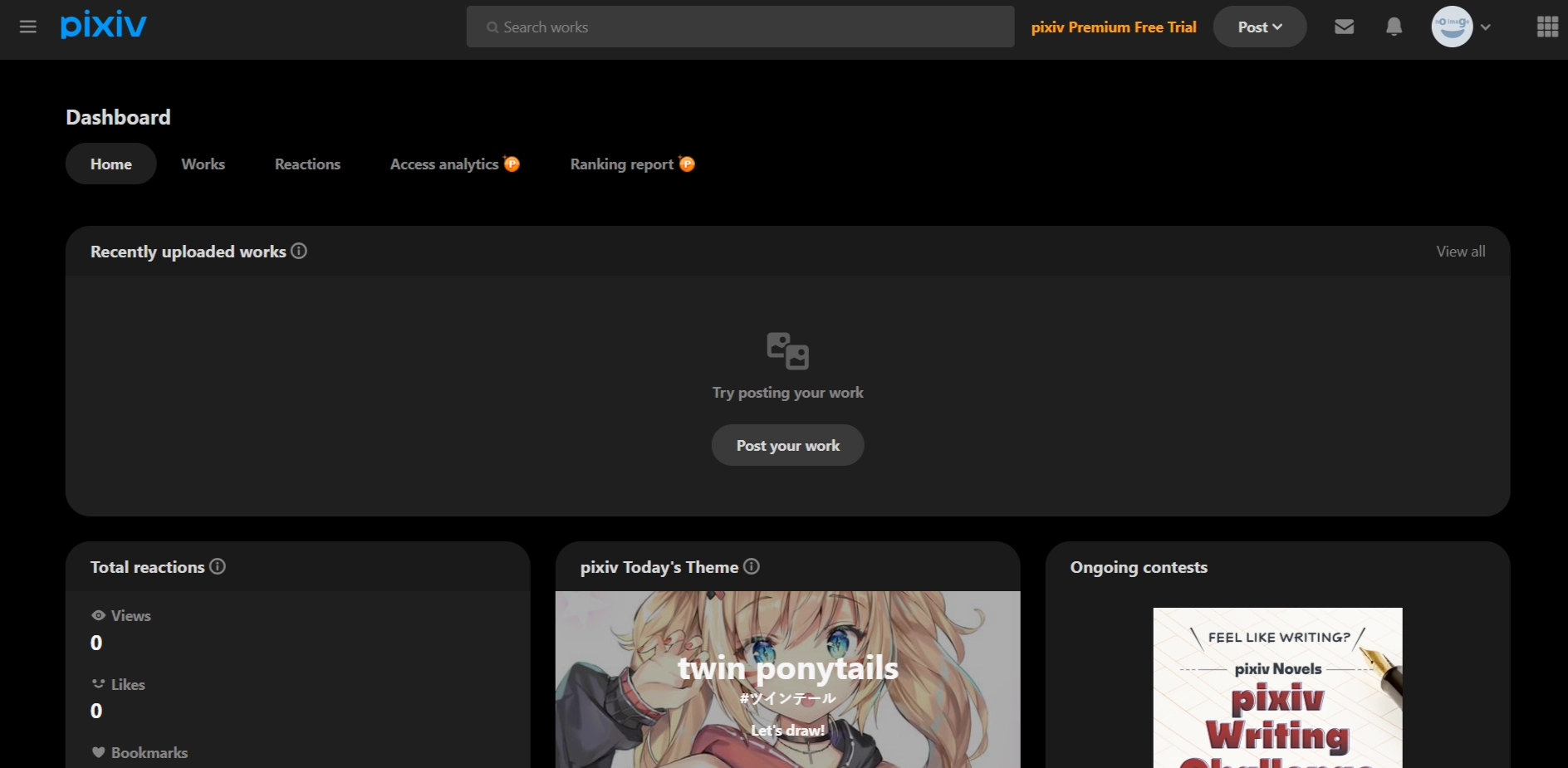
I think of Pixiv as a creator publishing platform built around discovery. Here, you can post illustrations, follow artists, use tags, and get found through feeds, rankings, and browsing culture.
Pixiv’s biggest strength is reaching inside an art-first culture. Artists can monetize their art through exposure, fan support links, and traffic to external platforms, and for many creators, that is enough at an early stage. The limits appear once income needs to be predictable. Brand control is minimal, product catalogs are not native, and selling is secondary to posting. Growth happens inside the platform UI rather than within an owned business.
That is why Pixiv is not the best option for every creator. Some need better tools for long-form publishing. Others want commissions with clearer rules. Many want to sell art as products, not just attract attention.
So, I looked beyond it. In this guide, I tested five Pixiv alternatives, each chosen for a specific strength: illustrations, manga, novels, community publishing, or direct selling. The goal is simple: show where Pixiv works well, where it stops working, and which alternatives make more sense as the art business grows.
pixiv vs pixivFANBOX
I treat Pixiv as the public discovery layer, while pixivFANBOX is the monetization layer where supporters pay for access to gated content and perks.
- Pixiv helps work get found through tags, feeds, and sharing. FANBOX turns that attention into recurring income through paid tiers and locked posts.
- Pixiv is optimized for reach and new viewers. FANBOX is optimized for retention, paid supporters, and consistent monthly revenue.
- Pixiv is “discover my work.” FANBOX is “pay to unlock extra value.” The content types can overlap, but their intent differs.
- Pixiv keeps the relationship mostly inside the platform. FANBOX adds a paywall and tier structure, but it is still not a true storefront for product-style selling.

My selection and testing process for Pixiv alternatives
All Pixiv competitors were tested using the same creator workflow, from publishing a post to trying to turn attention into revenue. I tracked where I had control, where the platform set the rules, and what started to feel limiting once I imagined posting and selling at higher volume.
Here is the criteria list I used across apps like Pixiv:
- Publishing and discovery flow (tags, feeds, browsing loops);
- Creator control (profile, presentation, links, rules);
- Monetization depth (support, sales, catalog potential);
- Scalability (what breaks when volume grows);
- Practical path from attention to revenue (steps and friction).
I tested the creator path more than the reader path. I reviewed pricing pages, monetization rules, and creator documentation, then mapped the steps required to publish, get discovered, and turn attention into revenue. I also checked what tools each platform gives me after the post goes live, like links, storefront hooks, analytics, or payout visibility. Finally, I looked at how easy it is to keep things consistent as output increases, including how a growing catalog is organized and how supporters or buyers are handled over time.
Sites like Pixiv in brief
|
Public posts, tags, rankings, bookmarks, and feeds. Premium adds browsing tools. |
Illustration-first discovery |
||
|
Portfolio site plus marketplace for digital assets and prints, with pro-facing discovery. |
Illustrations & portfolio credibility |
Free to publish. Viewer Ads requires thresholds. |
|
|
Episodic publishing format, series discovery, creator dashboard, and eligibility-based ads programs. |
Manga-style webcomics reach |
Free to publish. Viewer Ads requires thresholds |
|
|
Serialized prose and comics, reader support tools, creator programs, and strong comment habits. |
Free to publish. Ad Revenue Program terms include a 30% fee |
||
|
Owned storefront, instant digital delivery, discounts, upsells, email tools, analytics, custom domain. |
|||
|
Membership tiers, gated posts, predictable monthly support, and an optional merch tools add-on. |
The standard platform fee is 10% for new creators |
Top 5 Pixiv alternatives
These five options can be better fits in specific niches, like illustration portfolios, manga serialization, novels, or direct selling. If we’re comparing sites better than Pixiv, I treat that as “better for this job,” not “better at everything.”
ArtStation: The best Pixiv alternative for illustrations
Quick overview
ArtStation is an illustration-first portfolio platform with a built-in marketplace. It supports clean project presentation, client-facing profiles, and native selling for digital assets and prints. The niche leans professional, so the discovery loop feels closer to industry browsing than fandom feeds.

Why I picked ArtStation
I tested ArtStation because it sends the strongest portfolio credibility signal while still allowing native selling. It works well for illustration-focused creators who need visibility, professional presentation, and a light shop layer in one place. That balance makes it one of the most practical sites similar to Pixiv when reputation matters as much as sales.
Standout features
- Portfolio layout that stays clean even with a big body of work.
- Marketplace and prints built into the same identity.
- Custom domain option for a more owned presence.
Products you can sell
Digital assets such as brushes, asset packs, reference resources, and downloadable art files. Print products are also supported through the platform’s marketplace flow.
Integrations
Portfolio pages and marketplace listings connect inside the same account, so posts and products stay linked without extra tools. The main external dependency is payment processing handled through the platform checkout.

Learn how to sell online the simple way
Pricing
- Starter plan. Free to use. Marketplace sales have a seller fee of 5% plus payment processing fees (for example, 2.9% + $0.30).
- Best value plan. Pro is $9.95/month. I use it for stronger portfolio controls and a more “owned” presentation.
Pros and cons
| Pros | Cons |
|
A strong illustration portfolio signal for clients |
Discovery feels more pro than fandom |
|
Selling is native, not bolted on |
Less suited to casual social browsing |
|
Pro improves site control and presentation |
Community loop is weaker than feed-first platforms |
WEBTOON CANVAS: Best Pixiv alternative for manga
Quick overview
WEBTOON CANVAS is a webcomic publishing platform built for episodic series and large-scale reader discovery. It supports vertical-scroll formatting, series pages, and platform browsing that can surface new episodes to non-followers. Monetization exists, but it depends on eligibility-based programs.

Why I picked WEBTOON CANVAS
I tested WEBTOON CANVAS because discovery is the biggest advantage of platforms like Pixiv, especially for serialized manga. The reading flow and feed ecosystem are designed to surface ongoing series beyond an existing audience. It’s a strong pick when growth depends on consistent publishing and platform-driven reach.
Standout features
- Webcomic-first format that matches how readers binge.
- Clear path to ad monetization once a series is eligible.
- Creator dashboard and program structure that scales with consistency.
Products you can sell
Primary monetization is attention-based, with revenue coming through eligible ad programs and fan-paid features. The platform is better suited for growing a series and funneling readers than for selling downloadable files.
Integrations
Creator dashboards and monetization programs are native, so tracking and payouts run through the platform. External commerce typically requires linking out to a separate store or membership layer rather than true in-platform integrations.
Pricing
- Starter plan. Free to publish on CANVAS.
- Best value plan. Ad Revenue Sharing, once eligible. WEBTOON states that creators receive 50% of net ad revenue. Eligibility includes 40,000+ global monthly pageviews and 1,000+ subscribers.
Pros and cons
| Pros | Cons |
|
Strong discovery for serialized manga |
Format and release cadence are constrained |
|
Monetization can scale after eligibility |
Monetization is not guaranteed |
|
Reader behavior fits long-running series |
Strict platform rules shape what “works” |
Tapas: Best Pixiv alternative for novels
Quick overview
Tapas is an alternative to selling on Pixiv for prose and comics with strong community interaction. It supports episodic releases, reader engagement features, and multiple monetization paths that can unlock over time. The niche fits creators who publish consistently and build retention.

Why I picked Tapas
I picked Tapas because it fills a gap that other sites like Pixiv leave open for novels. It supports serialized prose with built-in community habits and more monetization layers than a pure posting feed. That makes it practical for writers who want audience engagement plus income options without running a separate store.
Standout features
- Built for serialized chapters and reader retention.
- Monetization paths that mix reader support and platform programs.
- Creator guidance that makes the earning model easier to plan.
Products you can sell
Monetization is centered on ongoing story access and reader support, not storefront-style file sales. Eligible creators can layer support tools, ad-based programs, and merch options once available.
Integrations
Payout handling and payment fee behavior matter most here, since monetization is routed through platform systems. Program access and payout flows are tied to Tapas tooling.
Pricing
- Starter plan. Free to publish and build an audience.
- Best value plan. Support-style monetization, once available to my account or series. Tapas explains that support contributions can route through fees like 15% on the web, and 30% on iOS/Android due to app store costs.
Pros and cons
| Pros | Cons |
|
Good fit for serialized novels |
Some monetization is eligibility-dependent |
|
More earning layers than “exposure only” |
Brand control stays platform-limited |
|
Clear support flow documentation |
Storefront ownership is not the core model |
Sellfy: Best Pixiv alternative for selling art
Quick overview
Sellfy is an all-in-one e-commerce platform for creators who want an owned storefront, and it will be your primary option if you’re looking for where to sell other than Pixiv. It supports digital product delivery, subscriptions, print-on-demand, and bundles, plus built-in marketing tools and analytics. The niche is direct-to-buyer selling and repeat purchases, not platform discovery.

Why I picked Sellfy
I chose Sellfy because the possibility of discovery can quickly become a trap. If you rely on the algorithm to find you, you’re a tenant. If you own the storefront, you’re the landlord.
- The economics: Marketplaces tax your growth. Owning the store means you stop paying “finder’s fees” for repeat buyers you’ve already earned.
- The destination: Sellfy replaces the “post-to-sell” grind with a controllable storefront. You move from chasing the feed to building a scalable catalog.
- The shift: It’s the transition from visibility to viability. It’s for the creator ready to stop playing the discovery lottery and start running a business

Standout features
- Automated digital delivery, so fulfillment stays hands-off.
- Built-in discounts, upsells, and analytics.
- Email marketing inside the platform.
- Custom domain support and storefront customization.
- 0% transaction fees on plans, which changes the math as volume grows.
Products you can sell
Digital art products such as brushes, textures, print-ready files, tutorials, and downloadable resources. Subscriptions, bundles, and print-on-demand merch are also supported for expanding beyond one-off downloads.
Learn how to sell online the simple way
Integrations
Payment processing runs through major providers such as PayPal and Stripe, and tracking can connect to tools like Facebook Pixel. The integrations that matter most are payments and attribution, since traffic typically comes from external channels.
Pricing
- Starter plan. Starter is $22/month billed annually ($29 billed monthly). It is positioned for smaller sellers, with a $10k yearly sales limit.
- Best value plan. Business is $59/month billed annually ($79 billed monthly). It raises the ceiling to $50k yearly sales and adds stronger scaling room for growth.
Pros and cons
| Pros | Cons |
|
Strong fit for shops like Pixiv built for commerce |
I need to bring traffic since there is no feed |
|
Brand ownership with a custom domain and store control |
|
|
Marketing tools help drive repeat buyers |
Patreon: Best Pixiv alternative for fan memberships
Quick overview
Patreon is a membership platform designed for recurring fan support and gated content delivery, and it can be better than Pixiv when the goal is retention and predictable monthly support. It supports tiered subscriptions, members-only posts, and community-style retention features.

Why I picked Patreon
I chose Patreon because recurring memberships are its core strength, closely matching the pixivFANBOX model. It’s built for predictable monthly revenue tied to ongoing content rather than one-off transactions. This makes it a solid choice for creators prioritizing retention and supporter relationships.
Standout features
- Membership tiers and gated content are the core product.
- Fans already understand the monthly support model.
- Add-ons like merch can fit retention strategies.
Products you can sell
Access-based benefits such as members-only posts, early releases, behind-the-scenes content, and gated downloads. The platform works best for subscription perks rather than a growing standalone product catalog.
Integrations
Patreon typically functions as a membership layer alongside other tools, with creators linking out to stores or publishing platforms. Operationally, the key integration points are payout reliability and how the membership layer fits into an existing stack.
Pricing
- Starter plan. Standard plan uses a 10% platform fee, plus payment processing and other applicable fees.
- Best value plan. Standard plan plus the Merch add-on if I want physical perks. Patreon lists the merch add-on at 3%.
Pros and cons
| Pros | Cons |
|
Strong recurring revenue model |
Not built for one-off transactional selling |
|
Low friction for fans who already use Patreon |
Not an online marketplace like Pixiv |
|
Works as a membership layer alongside a store |
Brand control stays within Patreon UI |
Which Pixiv alternative is the best?
I use Pixiv-style ecosystems for reach. They are good for publishing, community feedback, and getting found through browsing. That is why I keep options like ArtStation, WEBTOON CANVAS, and Tapas in my stack, depending on format.
My decision changes when selling becomes the main goal. If I want ownership, a growing catalog, and repeat buyers, Sellfy is the clearest long-term play. I get a storefront, a conversion-focused checkout, and built-in marketing tools that help me sell beyond a single post.
If I catch myself thinking about Pixiv vs a store, I simplify it. Pixiv is a discovery culture, where reach comes from the feed, tags, and community browsing. Sellfy is commerce ownership, where the store, checkout, and marketing tools are built for repeat buyers. I pick based on what I need next, not what is universally “best.”

Aleksey is a Content Marketing Specialist at Sellfy. He loves using language and the power of words to make even the driest eCommerce topics fascinating. Using his degree in literary studies and passion for the latest trends, he creates well-researched and structured content to inspire other people and help them grow their eCommerce business.