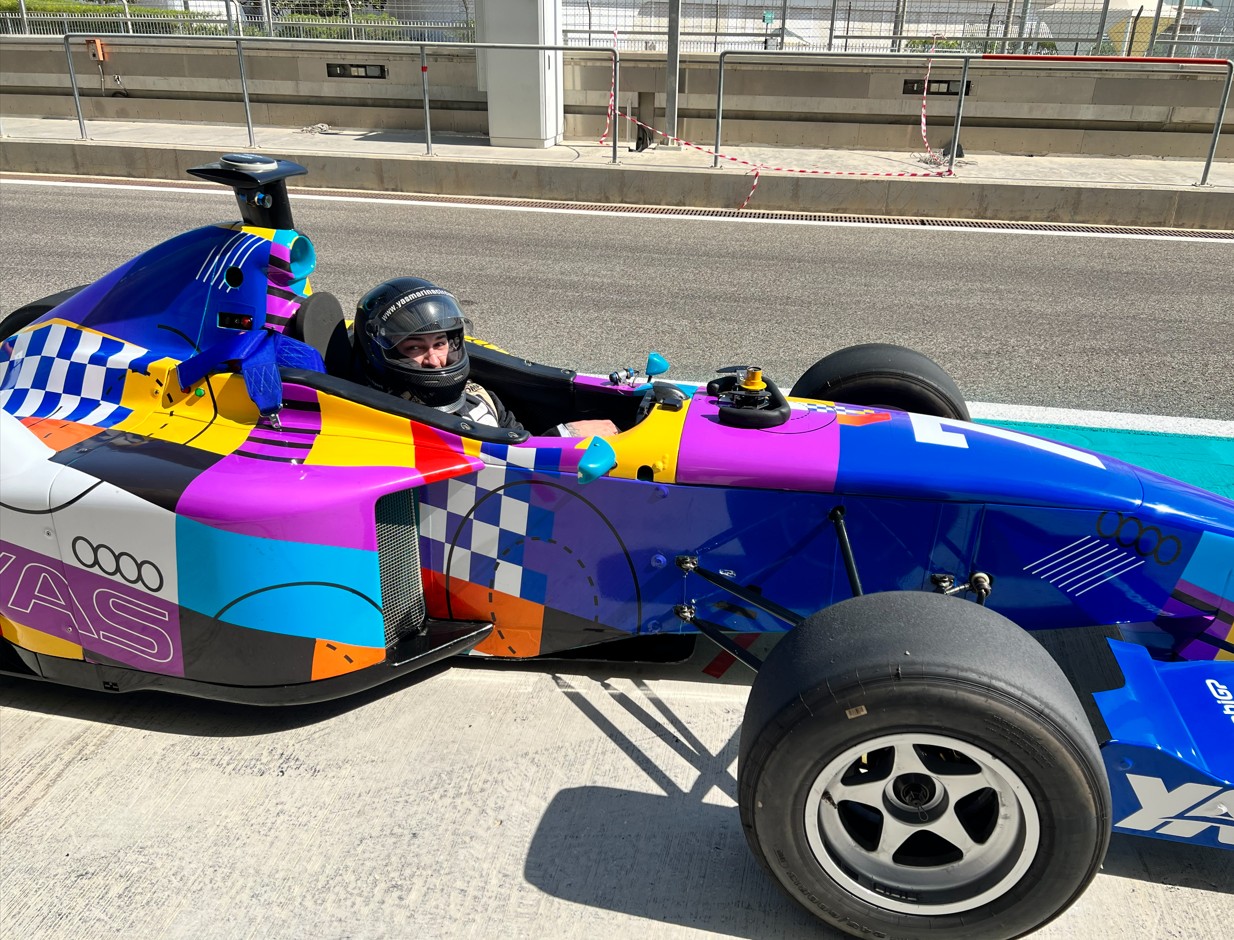
Race Sim Studio creates premium digital racing cars for driving simulators. It started as a passion project between like-minded creators on an internet forum. And over the past decade, Race Sim Studio (RSS) evolved into a globally respected virtual racing design studio trusted by professional drivers, automotive brands, and serious sim racers alike.
Founded by three experts obsessed with quality and sim design realism, the team behind Race Sim Studio isn’t one to chase shortcuts or quick wins. Instead, they built their reputation slowly, focusing on high standards, expert technical knowledge, and a willingness to spend a lot more time on each product than the industry norm.
Since 2017, RSS has sold its entire catalogue exclusively through their digital storefront powered by Sellfy. Today, Sellfy remains one of the central aspects of their business, handling digital delivery, payments, customer communication, and storefront management, allowing RSS to focus on what they do best – building world-class simulation vehicles.
In this case study, I sat down with the director of Race Sim Studio Ali Goz to talk about how the business began, how it grew, what it takes to maintain quality at scale, and why Sellfy still plays a central role ten years on.

Describe your business to someone who knows nothing about your industry.
We create premium digital racing cars for driving simulators. That’s the core of what we do. Our focus is realism, accuracy, and long-term usability. We aim to replicate how real race cars look, feel, and behave.

Our products appeal not only to gamers but also to serious sim racers, professional drivers, vehicle brands, and people working in the automotive and motorsport industries. Because we work with real-world motorsport professionals, a lot of our content can also be used as training tools.
We essentially expanded from a very niche, isolated section of gaming into a globally accepted product that people can use for a variety of reasons, be it entertainment, professional training and business purposes as well.
Who uses your products, and how does RSS fit into the industry?
The industry has evolved massively over the past decade, and it has let us push vehicle fidelity much further. In some areas, we can even outdo bigger-budget games simply because we can spend more time on each product.
Everything we do is PC-based. It’s not on console, mainly due to technical limitations. Our users typically have mid- to high-end PCs, and many also invest in proper sim racing equipment like steering wheels, pedals, and shifters. That hardware market has grown enormously over the last ten years, with increasingly better quality and lower costs.
What this gives people is access to motorsport in a way that would otherwise be impossible. You might spend £1,000 on a sim setup instead of several million pounds on a real racing programme, but that still provides a real sense of how a car behaves and a meaningful understanding of how a car behaves.

How did Race Sim Studio start?
It started on an internet forum for a game called Assetto Corsa. Between 2013 and 2016, I was spending time in the support forums, and that’s where I met David and Scott, my future business partners.
We each had very specific skill sets: 3D modelling, audio design, and vehicle physics, and it gelled together really well. We released a lot of content for free, which served great for improving our craft. But eventually, we realised we can’t support ourselves on a free endeavour forever.
By mid-2016, we had left the market entirely. Later that year, David suggested we try selling something.

Our first product was the Formula Hybrid 2017, released in early March 2017 on Sellfy. It didn’t explode overnight, but compared to the free content, the response was huge. And since then, the ball’s really been rolling.
Why did you choose Sellfy from the start?
We’ve been using Sellfy since early 2017. We wanted something clean and reliable. No unnecessary complexity. People want to add products to a basket, check out, and receive their files, all with just a few clicks.

Sellfy handled digital delivery better than anything else we found. Payment was smooth, it was cost-effective, and it allowed us to focus on product development instead of maintaining an e-commerce system.
Even today, anyone who wants access to our products gets them through Sellfy. Whether it’s a casual customer or a professional driver, I point them to our Sellfy store. It’s that simple.
Did you have a background in motorsport or game development before this?
I’ve loved motorsport from a very young age. If circumstances were different, I’d probably even be a professional driver. At the same time, I was very musically inclined, playing piano, guitar, and exploring music production. Surprisingly, those seemingly divergent sets of skills and interests ended up becoming very relevant for my career.
I got into sim racing as it was a cheaper and more accessible alternative to driving simulated vehicles. And, when the gaming platform opened itself up to modding, I started experimenting with engine sounds. My background in audio production and ear training allowed me to create more realistic sounds.
That’s how my name became known on the forums, where I met my business partners David and Scott, which eventually led us to creating Race Sim Studio.
None of this was planned as a business. I didn’t buy Assetto Corsa in 2013 thinking it would turn into my career.
What does the business look like now, ten years in?
We have a team of 10–15 specialist freelancers worldwide, allowing us to work around the clock. They’re experts across 3D modelling, audio design, and tool development. As the director or RSS, I handle the overall direction – product vision, finances, legal, and partnerships.
This setup keeps us flexible but allows us to maintain the high quality, with work moving almost around the clock. What’s exciting is that we’ve expanded our collaboration with professional drivers, making vehicle physics even more data-driven. For example, for this GT-M Furiano 96 V6 project, we got to work with Formula 1 Champion Max Verstappen.

The market has also changed drastically since I started, with lots more competition. Costs have risen sharply, and maintaining our high quality standard is increasingly challenging. What took a month in 2017 can take a year now, but market expectations are much higher, too.
How do you approach marketing?
We rely almost entirely on organic marketing. For our line of work, demonstrated product quality, long-term reputation and word-of-mouth matter more than aggressive promotion.
We’re very active on social platforms, especially Instagram, where we have 37.2K followers ( February 2026). And, we have a very engaged Discord community of over 15,000 people. They’re people who we have deep discussions with and who help shape our ideas. They’re also racing leads who use our content, and many of them we know by name.
Honestly, paid advertising hasn’t been particularly effective for us financially. In our case, credibility and word-of-mouth sells better than ads. I believe if you focus on quality, the rest tends to follow.
The Discord community seems central to your business. What are your approaches to nurturing and working with this large group of people online?
A few of us, including me, still spend around half our time engaging with the community. However, in 2026, we want to streamline that so we can focus more on the product.
I don’t think you can operate inside a black box. That’s why we constantly share how we work, what we’re developing, and why decisions are made.
At the same time, our biggest priority is to protect the community. We maintain clear ground rules to protect our work and the positive atmosphere in our space. Our space is about respect, constructive feedback, and shared enthusiasm, and we are strict in limiting negative noise or hostility.
I see it almost like looking after a family member. You protect them, and in doing so, you protect the business and the people working behind the scenes.
Any moments from the community that really stayed with you?
Giving back has always mattered to us. Even when we weren’t making much money, we ran giveaways.
One that stands out was sending a full wheel and pedal set to a young student in Finland years ago. It reminded me of how happy I was when I got my first wheel when I was their age.
We’ve done this consistently over the years, and we regularly get emails from people thanking us. I screenshot those and send them to the team. Those messages genuinely keep us going during high-stress periods.
We’ve also helped people build careers. Some have gone from our community into motorsport teams or professional roles. Seeing that cycle repeat is incredibly rewarding.

What have been the toughest moments for the business, and how did you work through them?
The biggest challenge has been scaling without sacrificing quality. As demand increased, we resisted the urge to move faster and instead stayed selective with projects and collaborators.
The costs and market expectations are higher than they ever were, and there’s more competition to consider. Projects that took a couple of months in 2017 can now take a year, and that’s the trade-off for maintaining trust and consistency.
We see the business as something that’s constantly evolving, so adapting our approach while protecting quality has been key.
What kind of revenue does a business like this generate?
So, our example shows you can make hundreds of thousands annually, but it requires lots of work and commitment, and a good understanding of what makes your business tick. You also have to remember there are costs like taxes involved, as well as research and development, and team salaries, so you don’t get to take all of that home.
To us, it’s never been about overnight success, it’s about long-term stability. We grow carefully rather than chasing spikes. I think that’s what has made us successful over the years.
And yes, with this type of business, you have flexibility, but you also have full responsibility.
Why do you still choose Sellfy after all these years?
Sellfy lets me focus on product development. It handles digital delivery, payments, storefront customisation, and customer communication without unnecessary complexity.
It’s dependable. It’s cost-effective. And I’ve watched it grow and improve alongside our own business.
I genuinely enjoy logging into Sellfy, checking how things are going, and knowing that if there’s ever an issue, there’s a team on the other side that listens.
What advice would you give to aspiring digital product creators?
- Focus on a few things and do them exceptionally well.
- Build trust with your customers and community by consistently providing high quality standards and responsiveness to their feedback.
- Think in years, not months.
- Reputation compounds far more than short-term marketing.
- And believe in yourself – there are plenty of successful people in the world, and you can be one of them.
Who would you recommend Sellfy to?
I think it’s ideal for independent creators and small teams selling digital products.
Sellfy is the most effective digital product commerce platform I’ve seen, and I come from a marketing, advertising, and finance background, so I’ve seen a lot. If you want something dependable without heavy technical overhead, I can’t recommend Sellfy enough.